

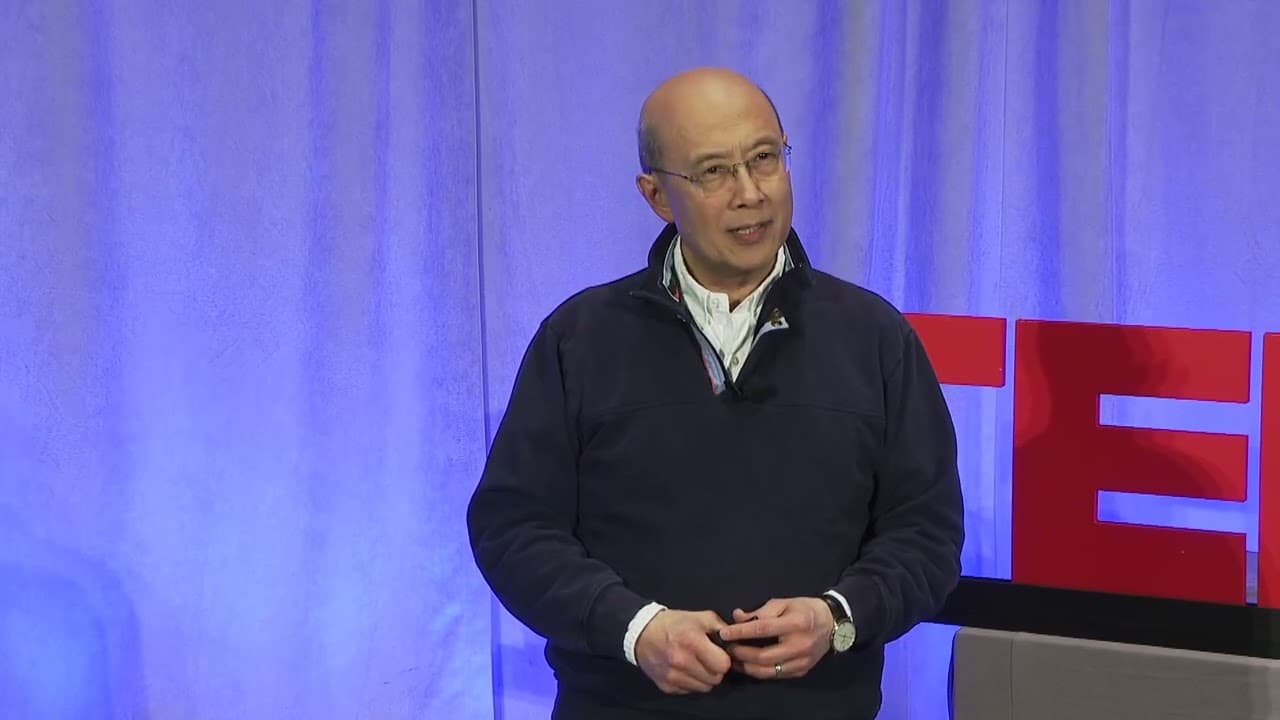
Watch Andrew in Action
About Andrew W. Lo
Is it irrational to assume that markets behave rationally? That question led Andrew W. Lo to rethink the efficient markets hypothesis, a cornerstone of modern financial theory, and down an unexpected path through behavioral finance, psychology, cognitive neuroscience, artificial intelligence and, ultimately, evolutionary biology. The result is the Adaptive Markets Hypothesis, set out in his acclaimed book Adaptive Markets, which explains how markets and financial institutions adapt to changing environments just as living species do. The hypothesis, he explains, "is meant to reconcile these two schools of thought in a framework that allows both to reflect their incredibly important contributions to what we experience in the real world."
Lo is the Charles E. and Susan T. Harris Professor at the MIT Sloan School of Management, director of the MIT Laboratory for Financial Engineering and a principal investigator at the MIT Computer Science and Artificial Intelligence Laboratory. Named one of the world's 100 most influential people by TIME, he is also a serial entrepreneur: founder of AlphaSimplex, an asset management company, and co-founder of QLS Advisors, Quantile Health, Uncommon Cures and BridgeBio Pharma, a biotechnology company developing therapies for genetic diseases. Inspired by his own family's struggles with access to cancer treatments, he works to bridge the gap between science and finance, helping health care institutions, drug companies and biotech founders improve patient outcomes along with their bottom lines.
Andrew's Keynote Topics
“Finance can be tremendously powerful when used properly, but it can be a dangerous weapon if incorrectly applied,” warns world-renowned MIT economist and financial scholar Andrew Lo, director of the MIT Laboratory for Financial Engineering. Drawing from his deep research, he discusses his framework for quantitatively measuring the financial reward, or cost, of impact investing, including socially responsible investing (SRI) and environmental, social and governance (ESG) issues. Using real world examples, he illustrates how the framework can be applied in such diverse areas as biotech venture philanthropy, “sin” stocks, ESG and “meme” stocks like GameStop.
Nonprofits routinely shoulder the burden of raising funds to fight diseases like cancer and many other life-altering or life-threatening diseases. But what drives corporate investment in potential cures? Profit or purpose? Drawing from his ongoing research, world-renowned MIT economist and financial scholar Andrew Lo, director of the MIT Laboratory for Financial Engineering, discusses the most pressing medical challenges of our time, why so many potential innovations and cures lack funding, and the ethics of drug pricing policies. Inspired by his own family struggles with gaining access to cancer treatments, he highlights the urgent need to bridge the gap between science and finance and explains how health care institutions, drug companies, vaccine makers and biotech founders can improve patient outcomes as well as their bottom lines by letting science drive investment—not vice versa—so that everybody wins.
Is it possible to build an ideal portfolio, one that perfectly balances risk and reward? In this talk, world-renowned MIT economist and financial scholar Andrew Lo, director of the MIT Laboratory for Financial Engineering, shares profound insights he learned from the world’s most prominent figures in the finance world, whom he profiled in his latest book “In Pursuit of the Perfect Portfolio.” He covers such areas as effective diversification, passive versus active investment, security selection and market timing, foreign versus domestic investments, derivative securities, nontraditional assets, irrational investing, and more. Acknowledging that the perfect portfolio is ultimately a moving target based on individual age and stage in life, market conditions, and short- and long-term goals, he explains why the fundamental principles for success remain constant in spite of changing market conditions.
Books by Andrew W. Lo

Healthcare Finance: Modern Financial Analysis for Accelerating Biomedical Innovation
Princeton University Press, 2022
In Pursuit of the Perfect Portfolio: The Stories, Voices, and Key Insights of the Pioneers Who Shaped the Way We Invest
Princeton University Press, 2021
Adaptive Markets: Financial Evolution at the Speed of Thought
Princeton University Press, 2017
Hedge Funds: An Analytic Perspective (New Edition): An Analytic Perspective
Princeton University Press, 2010
The Evolution of Technical Analysis: Financial Prediction from Babylonian Tablets to Bloomberg Terminals
Bloomberg Press, 2010
The Heretics of Finance: Conversations with Leading Practitioners of Technical Analysis
Bloomberg Press, 2009
The Industrial Organization and Regulation of the Securities Industry (National Bureau of Economic Research Conference Report)
University of Chicago Press, 2008
Dynamic Asset-Pricing Models (International Library of Financial Econometrics)
Edward Elgar Publications, 2007
The Derivatives Sourcebook (Foundations and Trends(r) in Finance)
Now Publishers Inc., 2006
The Dynamics of the Hedge Fund Industry
Research Foundation of CFA Institute, 2005Articles by Andrew W. Lo
Generative AI from Theory to Practice: A Case Study of Financial Advice
2024SSRNAccelerating Vaccine Innovation for Emerging Infectious Diseases via Parallel Discovery
2023Quantitative FinanceDeep-Learning Models for Forecasting Financial Risk Premia and Their Interpretations
2023The Journal of Portfolio ManagementFrom ELIZA to ChatGPT: The Evolution of Natural Language Processing and Financial Applications
2023PNASHamilton’s Rule in Economic Decision-Making
2022Collective IntelligenceThe Wisdom of Crowds Versus the Madness of Mobs: An Evolutionary Model of Bias, Polarization, and Other Challenges to Collective Intelligence
2022SSRNSocial Contagion and the Survival of Diverse Investment Styles
2021MIT Sloan Management ReviewLessons From Hollywood: A New Approach to Funding R&D
December 2015Andrew Lo's MIT Publications Page
Andrew W. Lo's Google Scholar Profile
Andrew in the Media

Why AI Chatbots Can’t Be Trusted for Financial Advice: They’re Sociopaths

When AI Makes Sharper Stock Predictions ($)

MIT’s Andrew Lo Sees AI Ready to Run Your Money in Five Years

Can AI Replace Financial Advisors? Experts Warn Against Using AI for Much Besides Basic Financial Advice

The Top 10 MIT Sloan Articles of 2024

How Lessons From Biotechnology Can Help Unlock the Future of Fusion Energy

AI Could Soon Act as an Ethical Financial Advisor, MIT Researchers Predict
Can Generative AI Provide Trusted Financial Advice?

From Financial Markets to ChatGPT: A Conversation With Andrew Lo
Let’s Choose Collective Intelligence Over the Madness of Mobs
New Study Suggests Evolutionary Forces Are Behind Collective Discrimination

Innovative Solutions To Cancer Require Innovative Finance: Cancer Moonshot Pathways
Ever wonder if there is a better way to invest? In Pursuit of the Perfect Portfolio does a marvelous job setting out answers by taking readers through the evolution of modern investment management. Combining interesting anecdotes with fulsome explanations, the authors provide a roadmap for how portfolio selection has developed. Accessible to new and experienced investors, this book makes clear that the search for the perfect portfolio is an engaging and never-ending quest.
Maureen O’HaraFormer President of the American Finance Association
This is a wonderful book. Andrew Lo traces a journey in which he reconsiders rationality in economics, moving from the efficient market hypothesis to his own Adaptive Markets Hypothesis through psychology, neuroscience, biology, and studies of financial innovations and crises. The book presents many valuable findings and is also full of emotion―enthusiasm, joy, frustration, and pain. It is itself a manifestation of the important finding that rational thinking and emotion go together.
Nobuhiro KiyotakiPrinceton University
Andrew Lo combines wonderfully broad scholarship and a delightfully instructive style to present dramatically new perspectives on how markets work and how they can be regulated more effectively. This important book will teach and entertain, and should influence those charged with keeping markets healthy.
Simon A. LevinPrinceton University
Bring Andrew to your next event
Tell us about your event and we will be in touch right away.


