


Watch Rana in Action
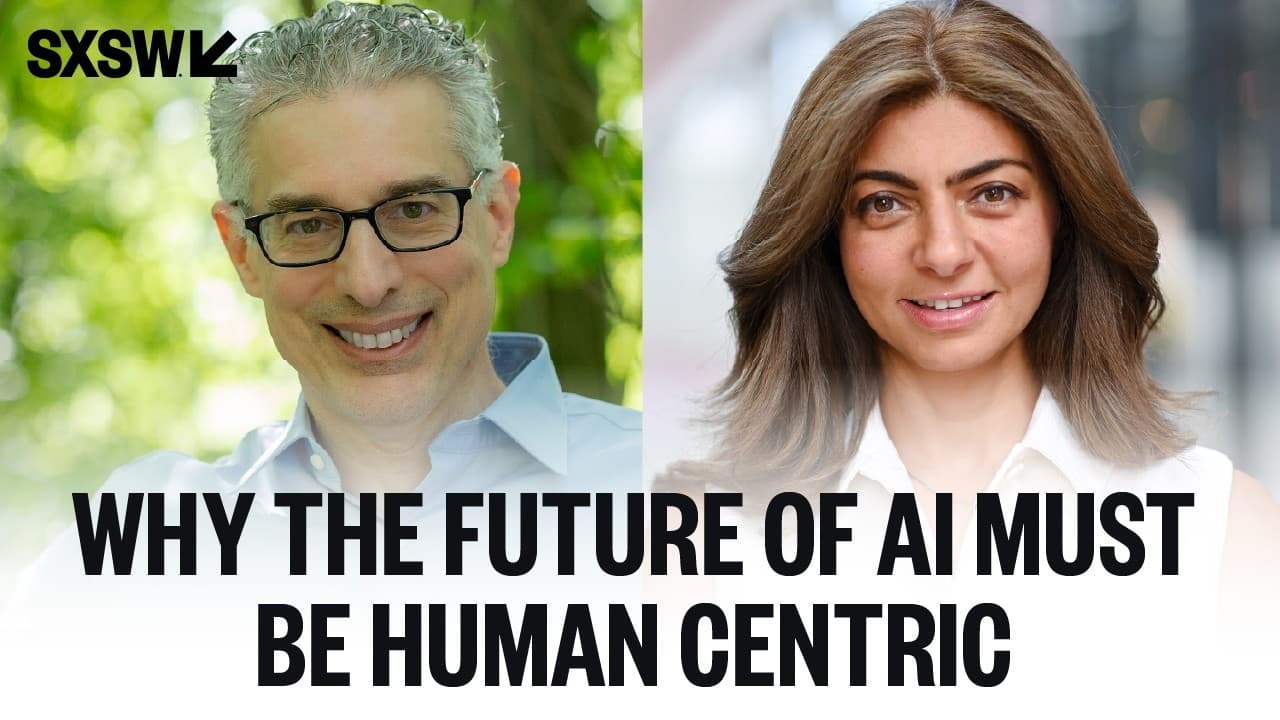
About Rana el Kaliouby
Rana el Kaliouby has spent her career teaching machines to understand people. As co-founder and CEO of Affectiva, the MIT spinoff that pioneered Emotion AI, she invented award-winning emotion recognition technology trained on more than 12 million faces analyzed across 90 countries. A quarter of the Fortune Global 500 have used it to test how consumers respond to ads, videos and TV programming, and leading automotive companies use it to improve road safety. After the acquisition, she served as deputy CEO of Smart Eye and remains an AI advisor.
Today, as an investor and educator, el Kaliouby helps organizations develop what she calls an AI mindset. "Small changes to how you approach AI transformation can have a big impact," she says. "Show you respect privacy and safety by declaring an AI ethics policy consistent with your business values. Success will boil down to team, culture and people." Her keynotes and executive education sessions use her own companies as proof points, mapping where to invest to capitalize on data insights, how to de-silo organizational data, and how to keep ethics at the center as adoption accelerates.
Rana's Keynote Topics
Today’s devices work hand-in-hand with humans –at work, home, school and play. Rana el Kaliouby, Ph.D., co-founder and managing partner at Blue Tulip Ventures, believes they can do much more. An expert in artificial emotional intelligence, or “Emotion AI,” el Kaliouby explores the valuable applications of humanized technology in media and advertising, gaming, automotive, robotics, health, education and more. She explains how machine learning works, explores the potential for the development of emotion chips, and addresses the ethics and privacy issues of Emotion AI. In her talks, el Kaliouby gives participants an inside look at the world’s largest emotion data repository, shares results from her research studying more than 5 million faces around the world, and reveals that the emoji mindset may soon be a thing of the past.
Organizations have access to more data than ever before, but few are leveraging that data to its fullest potential. A visionary pioneer in the AI field, Rana el Kaliouby has a practitioner’s view of how to utilize organizational data in a way that creates new opportunities. Co-founder and managing partner at Blue Tulip Ventures, her blueprint provides reliable and practical guidance for organizations embarking on an AI implementation journey. A successful leader of two AI-first companies (Affectiva and Smart Eye), el Kaliouby shares with leaders various methods for understanding the existing wealth of data at their fingertips, then shows them how to leverage that data to resolve various business challenges. With a leader’s perspective, she effectively demonstrates how to communicate about AI transformation in a way that gets stakeholders to envision the possibilities and get on board. By showing how AI tools can lead to not just economies of scale but also economies of scope, el Kaliouby teaches leaders at organizations of any size how they can use AI to discover new opportunities and design competitive advantages where previously none existed.
The speed of doing business in the 21st century is accelerating, and human-powered organizations must find an edge to remain competitive. For many businesses, this advantage can come from AI tools, but deploying them effectively requires developing an AI mindset, says Rana el Kaliouby, an early founder in the AI field. Co-founder and managing partner at Blue Tulip Ventures and a Harvard Business School executive fellow, el Kaliouby bridges industry experience and academics to deliver practical guidance on the cultural transformation steps required to take advantage of this disruptive technology. Informed by experience, she delivers a “how to” guide to AI implementation, covering germane topics including where organizations need to invest to capitalize on data insights, how to break down data siloes, why an AI ethics statement matters and how to create one, and which low-hanging milestones to acknowledge. Candid and peppered with entertaining and inspiring stories, el Kaliouby’s vivid case studies show businesses how to weave AI throughout the fabric of their organization in a way that helps them automate, accelerate, innovate and, ultimately, increase profits.
With any technology advances and automation of tasks, it’s inevitable that jobs will change or disappear. However, artificial intelligence will, at the same time, create many new types of jobs that did not exist before, augment our abilities, and complete menial tasks to free humans up to do higher-level strategic thinking and decision-making. Computer scientist and AI expert Rana el Kaliouby, Ph.D., envisions a world in which devices interact with us the same way we interact with one another – through conversation, perception and emotion. Before long, we won’t even remember when our relationship with technology was any different. El Kaliouby, co-founder and managing partner at Blue Tulip Ventures, is ensuring that in the near future our devices will have an emotion chip that can sense and react to people’s cognitive and emotional state with accuracy and empathy. Our mobile phones, cars, smart TVs, personal digital assistants and even our household appliances will be able to sense our emotion and cognitive states.
In this presentation, el Kaliouby reveals eight major ways that emotion AI will transform the future of work – from productivity companions and human-robot teams, to a complete re-imagination of our travel experiences and how we connect with one another – showing business leaders how new jobs will be created and why they must rethink how employees are trained (and re-trained) for the constantly evolving technology and business landscape.
Rana el Kaliouby, co-founder and managing partner at Blue Tulip Ventures, has been thinking about how artificial emotional intelligence (Emotion AI) could preserve our emotions in a digital world: for example, understanding audience engagement during virtual events and meetings, gauging students’ reactions and comprehension in e-learning scenarios, and monitoring people’s mental health and wellbeing as many are dealing with anxiety right now. In this presentation, el Kaliouby will discuss the role of tech in keeping us connected and how to preserve the qualities that make us human – our emotions and understanding of one another – as we increasingly live and work online.
Recent innovations around the autonomous car are shaking up the automotive industry. Beyond the issues of driverless or semi-autonomous vehicles, cars of the future are undergoing a fundamental shift in human-machine interaction. Consumers today crave more relational and conversational interactions with devices, as evidenced by the popularity of chatbots and virtual assistants like Siri and Alexa. Next-generation cars are emerging with advanced artificial intelligence systems that include conversational interfaces between the driver, passengers, the vehicle itself and its controls – all connected to the Internet of Things (IoT) and mobile devices individuals use. Leveraging emotion recognition technology that senses and analyzes expressions of emotion, cars will soon come equipped with the ability to perceive our reactions and moods and respond accordingly. Rana el Kaliouby, Ph.D., co-founder and managing partner at Blue Tulip Ventures, shows how these “emotionally aware” vehicles will benefit the automotive industry and consumers in a number of ways, such as improving road safety and jacking up the in-car experience with optimal personalization.
Having launched her career in the “affective computing” space where she trained algorithms to infer human feelings from facial expressions, Rana el Kaliouby, co-founder and managing partner at Blue Tulip Ventures, understands how new technology like AI can have an emotional impact on us. When a company starts to incorporate AI tools into their processes, employees and customers alike may feel concerned about privacy or safety. The secret to bringing the advantages of AI to an organization, says el Kaliouby, is to lead with empathy. When a leader shows they understand fears and concerns associated with artificial intelligence, they can unleash an AI mindset, getting people excited to envision the possibilities of an AI-enabled organization. Drawing on her experience as a pioneering AI founder, el Kaliouby offers actionable advice on how leaders can alleviate fears about job elimination, privacy, safety and more. Honest, forthright and engaging, el Kaliouby offers leaders a reliable model for leading with empathy in the Age of AI.
Rana el Kaliouby, Ph.D., co-founder and managing partner at Blue Tulip Ventures, has always placed ethics at the heart of her mission as a scientist and entrepreneur. In addition to being true to her beliefs, avoiding bias and respecting consumer privacy with technology has served as a successful business strategy as well. Affectiva, el Kaliouby’s company which she co-founded and served as CEO at, has grown to become a notable AI startup by positioning itself as an ethical organization. Under her leadership, Affectiva has gone as far as to turn down multimillion-dollar investments with entities whose practices and goals did not align with the founders’ moral values. Far from dooming Affectiva, this business strategy allowed it to thrive and attract the growing ranks of investors concerned with making money responsibly. This strategy, however, is not without risks. In this presentation, el Kaliouby tells the story of how she built a morally rooted AI startup and convinced stakeholders to endorse a strategy that at times seemed fraught with challenges. As consumers and investors increasingly demand transparency and worry about the drawbacks of being part of a controversial organization, building an ethical business will be more of a necessary challenge to senior leaders and entrepreneurs. El Kaliouby has been there, done that and has crucial lessons for everyone treading the same path.
In a captivating memoir, an Egyptian-American visionary and scientist provides an intimate view of her personal transformation as she follows her calling—to humanize our technology and how we connect with one another.
Rana el Kaliouby is a rarity in both the tech world and her native Middle East: a Muslim leader, AI entrepreneur and a woman in charge in a field that is still overwhelmingly white and male. Growing up in Egypt and Kuwait, el Kaliouby was raised by a conservative father who valued tradition yet also had high expectations for his daughters, and a mother who was one of the first female computer programmers in the Middle East. Even before she broke ground as a scientist, she broke the rules of what it meant to be an obedient daughter and, later, an obedient wife to pursue her own daring dream.
After earning her Ph.D. at Cambridge, el Kaliouby, now the divorced mother of two, moved to America to tackle the growing empathy crisis in our culture. The majority of our communication is conveyed through non-verbal cues: facial expressions, tone of voice, body language. But that communication is lost when we interact with others through our smartphones and devices. The result is a digital universe that’s emotion blind, rendering us functionally autistic in cyberspace. To combat our fundamental loss of emotional intelligence online, she co-founded Affectiva, the pioneer in the new field of Emotion AI, enabling our technology to understand humans the way we understand one another. “Girl Decoded” chronicles Rana el Kaliouby’s journey from a “nice Egyptian girl” to a woman carving her own path as she revolutionizes technology. But decoding herself—learning to express and act on her own emotions—would prove to be the biggest challenge of all.
AI-based virtual assistants are evolving quickly, and now, increasingly more effort and resources are being put toward making them emotionally intelligent – able to pick up on subtle cues in speech, inflection, or gesture and expression to assess a person’s health and wellbeing. Nurse avatars and social robots – such as Catalia Health’s Mabu, an emotion-aware personal care companion for terminally ill patients – are already proving their abilities to enhance patient-centered health care environments around the world, making routine processes more efficient, and improving experiences and outcomes. But their full potential is even more profound, and far from realized, believes Rana el Kaliouby, Ph.D., co-founder and managing partner at Blue Tulip Ventures.
Emotion AI, she says, provides an opportunity to transform numerous aspects of health and wellbeing, from telemedicine and drug efficacy to mental health research and autism support. By reading into vocal tone or detecting facial expressions, for example, emotion AI-enabled platforms could detect depression or even potentially underlying chronic conditions, such as heart disease. In telemedicine, mood-aware wearables could contribute to monitoring mental health and wellbeing, perhaps helping those with depression track their emotional state and share that data with their doctor.
Our emotional wellbeing and our health is intertwined, el Kaliouby explains. She discusses the future of health care – through the lens of emotion AI, delving deep into how far it has come and helping envision how far it can still go. Its promise is powerful.
As AI becomes more sophisticated, it will be increasingly performing or aiding in important tasks traditionally done by humans — from driving cars to teaching our children and caring for the sick and elderly. Given the nature of these roles, we should be able to trust the AI systems with which we will be interacting. It’s paramount that developers building these systems carry out their work with these considerations in mind, and create the next generation of AI with trust as its cornerstone. Rana el Kaliouby, a leading pioneer in Human Perception AI, argues that the basis of trust is empathy, and ensuring AI is empathetic is key to having humans trust its competence. In this presentation, el Kaliouby outlines her “5 Tenets of the Social Contract Between AI and Humans.” She argues that to avoid systemic bias, diversity must be reflected not only in the data used to build the AI capabilities of the future, but also in the teams developing the systems. More specifically, AI has to be attuned to the needs of humans, understanding our complex emotions and cognitive states, and adapting to these appropriately. This framework will be essential to the companies and individuals who are forging the future, ensuring they make AI less artificial and more human.
Through Emotion AI, Rana el Kaliouby, Ph.D., co-founder and managing partner at Blue Tulip Ventures, is at the forefront of developing and deploying artificial intelligence that goes far beyond performing routine, repeatable tasks. But the ability to create such technology also requires an ethical structure for doing so. As we face the consequences of AI that doesn’t recognize fundamental human values, el Kaliouby reveals how her journey as a scientist and entrepreneur has positioned her to address important ethical questions relating to potential bias, privacy and other issues that are increasingly a matter of public debate. She provides strategies for both the development of AI solutions and their practical deployment, teaching organizations how to factor ethical considerations into both areas. Instructional as well as inspiring, this keynote can form the beginnings of a conversation for companies, entrepreneurs and academics alike on how ethics must catch up with the overwhelming pace of technological advancement that is reshaping our world.
Books by Rana el Kaliouby

Articles by Rana el Kaliouby
Women in #AI: The Next Chapter
October 2023Automotive WorldWhat Are the Key Considerations for Ethical Automotive AI
April 2023Automotive News EuropeGet Ready for a Wave of Human-Centric Sensors
December 2022AffectivaFace Value: The Power of Facial Signals in Human Behavioral Research
December 2022LinkedInGetting a Seat at the Table and Then Making It Count!
March 2022LinkedInHow to Bring People on Board With Your Idea
February 2022LinkedInKey Takeaways From Fortune Brainstorm AI
November 2021Thrive Global3 Ways to Show Emotions While Wearing a Mask
June 2020Fast CompanyEmotionally Aware Technology Could Help Us Beat Zoom Fatigue
June 2020Inc.How to Be an Empathetic Leader in Times of Crisis
June 2020World Economic ForumDecoding our Emotions in a Highly Coded World
May 2020Porchlight Book CompanyBuilding Ethical, Empathic and Inclusive AI
April 2020Rana in the Media

How attitudes toward AI differ across generations
Government benefits are broken. Is AI the fix?

Why This AI Pioneer Warns: “Robot Companions Could Change Us Forever”
Gen Z isn’t happy about AI. Even when mom helped invent it.

AI’s ‘Boys’ Club’ Could Widen the Wealth Gap for Women, Says Rana el Kaliouby

Where AI is headed in the new year (with AI pioneer Rana el Kaliouby) | Rapid Response
el Kaliouby: Humans Can Leverage AI to Improve the World
Egyptian-American Scientist Rana el Kaliouby Explores Ethical AI in New Podcast Series
Rana el Kaliouby & HBS Professor Karim Lakhani: How AI is impacting productivity at work
Strategy Session: Navigating the future of AI in 2024 (with Rana el Kaliouby) | Masters of Scale
Global AI Agreement “Impossible” and Companies Should Avoid Tech-Specific Policies, Experts Warn

Former Affectiva CEO, CMO to Invest in AI with New VC Firm
Bring Rana to your next event
Tell us about your event and we will be in touch right away.


