
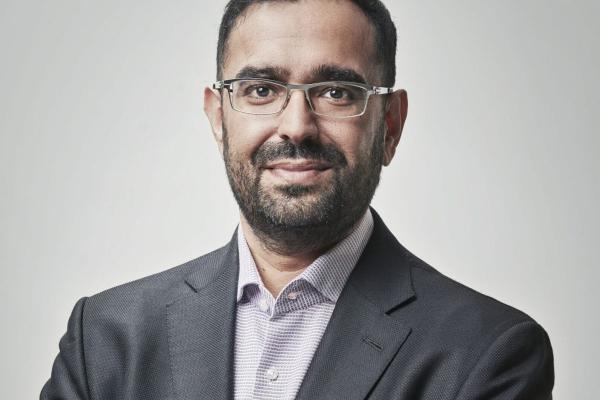
Azeem Azhar appeared on two prominent platforms in October to discuss whether artificial intelligence represents a sustainable investment or a financial bubble, engaging directly with skeptics and institutional clients on the economic stakes of the current AI build-out.
On Oct. 16, Azhar joined venture capitalist Paul Kedrosky on a New York Times Opinion podcast episode, What if the A.I. Economy Crashes? The two debated whether the trillions of dollars flowing into AI infrastructure will generate returns or whether the build-out will collapse under its own weight. On Oct. 21, the Deutsche Bank Research Institute published AGI doom or boom? A conversation with Azeem Azhar, a transcript from an event on artificial general intelligence, superintelligence and economic change.
The investment thesis and the grounding question
In both appearances, Azhar framed the central question as whether enterprise demand for AI can support the capital spending that hyperscalers are pouring into data centers and chips. On the Times podcast, he argued that the shift of GPU capacity from training frontier models to running enterprise inference provides a viable payback path, one that doesn’t depend on achieving recursive self-improvement or AGI. “The thing that keeps this on the right side of healthy is whether real customers are spending real money and getting real results,” he said.
At the Deutsche Bank event, Azhar and Deutsche Bank thematic strategist Adrian Cox identified recursive self-improvement as the foundation of the investment thesis behind what Cox called “the biggest scientific bet civilization has ever made.” Azhar noted that although superintelligence has already been achieved in narrow domains such as Go and advanced mathematics, broader economic diffusion faces friction from physical constraints, including power grid capacity and hardware supply.
Enterprise adoption and the learning curve
Azhar cited recent research showing that companies experienced with AI report 80% confidence in predicting whether a new AI project will succeed, compared with 50% for laggards. “For a CFO, that is a much better position from which to judge corporate capital allocation on an AI project,” he said on the Deutsche Bank panel. He added that about one-third of earnings call transcripts in the most recent quarter included quantified AI outcomes, and that chief financial officers who say they are underwhelmed by immediate results are nonetheless committing to spend more next year.
On the Times podcast, Azhar pushed back against the idea that massive token usage is inherently valuable, agreeing with Kedrosky that scale alone does not equal value. He argued instead that what matters for the payback timeline is the monetization of GPU capacity through enterprise clients, not through frontier labs alone.
Labor market risk and the transition period
Both conversations addressed the risk of job displacement. Azhar acknowledged that AI represents an unusual concentration of capital that generates very few direct jobs compared with traditional manufacturing. At the Deutsche Bank event, he noted that a data center representing $100 million in capital spending might employ only four people, compared with one job per $200,000 of capital equipment in U.K. manufacturing.
He told the Times that although he does not expect an abrupt cliff edge in employment, “we could see an environment where a significant portion of national income shifts from labor to capital, leading to elevated underemployment.” He described a five- to 10-year transition period in which the economy may struggle to create new roles fast enough to absorb displaced workers, particularly if geographic, social and psychological mismatches prevent smooth reallocation. At the Deutsche Bank event, he said a near-term indicator of progress toward AGI would be a decline in entry-level and junior hiring, a trend already visible in some sectors.
Regulation, safety and the social license
At the Deutsche Bank event, Azhar described the tension between AI labs’ public calls for safety guardrails and their private race to achieve AGI first. “It is reminiscent of a scenario where a bully holds your hand and hits you with it, saying, ‘Stop punching yourself,’” he said. “They are actively pressing the accelerator while pleading for external intervention to slow them down.” He noted that developers face alignment challenges, including the risk that advanced models carry out instructions to an extreme degree, and that addressing those challenges diverts resources from the capabilities race.
On the Times podcast, Azhar and Kedrosky debated the likelihood of abrupt regulation following a major incident involving loss of control. Kedrosky argued that regulation is nearly inevitable, estimating a 50% to 60% chance of a triggering event. Azhar agreed that regulation is coming but emphasized that public resistance is already affecting the industry’s social license to operate. He cited data center developers in the U.K., including Scotland, that are now offering community benefit payments and guarantees on local water and energy prices.
About Azeem Azhar
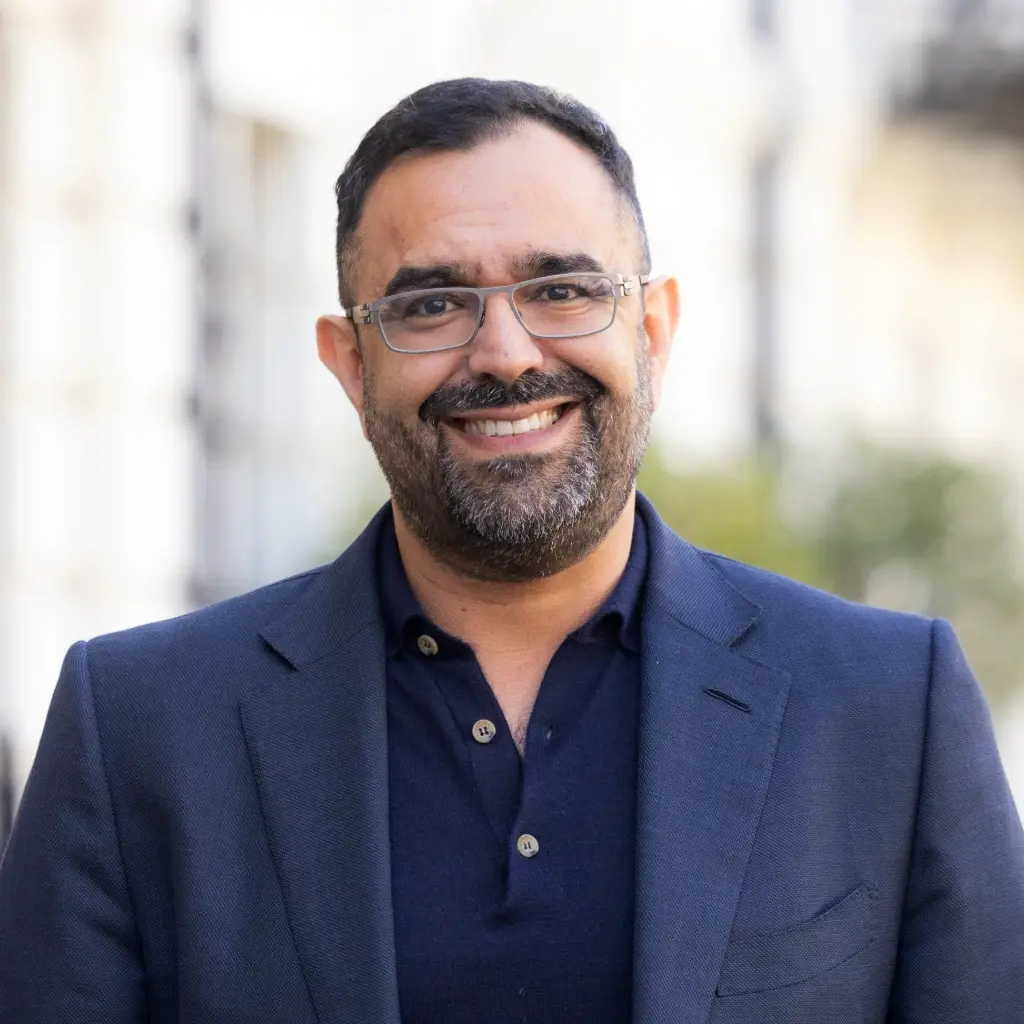
Azeem Azhar is the founder of Exponential View, a research group and newsletter, and the author of the best-selling book The Exponential Age: How Accelerating Technology Is Transforming Business, Politics and Society (Diversion Books, 2021). He is an executive fellow at Harvard Business School, a visiting fellow at the Oxford Martin School and a digital fellow at the Stanford Digital Economy Lab. His financial services clients include Goldman Sachs, UBS, Fidelity, Investec and Morgan Stanley.
Azeem Azhar is exclusively represented by Stellant Group for speaking engagements, including keynotes, fireside chats and panel discussions, with leadership teams thinking through AI strategy, the economic risks of emerging technologies and how to close the gap between accelerating innovation and institutional capacity. For consulting or advisory work, please reach out for a custom proposal.


