

Watch Nicholas in Action
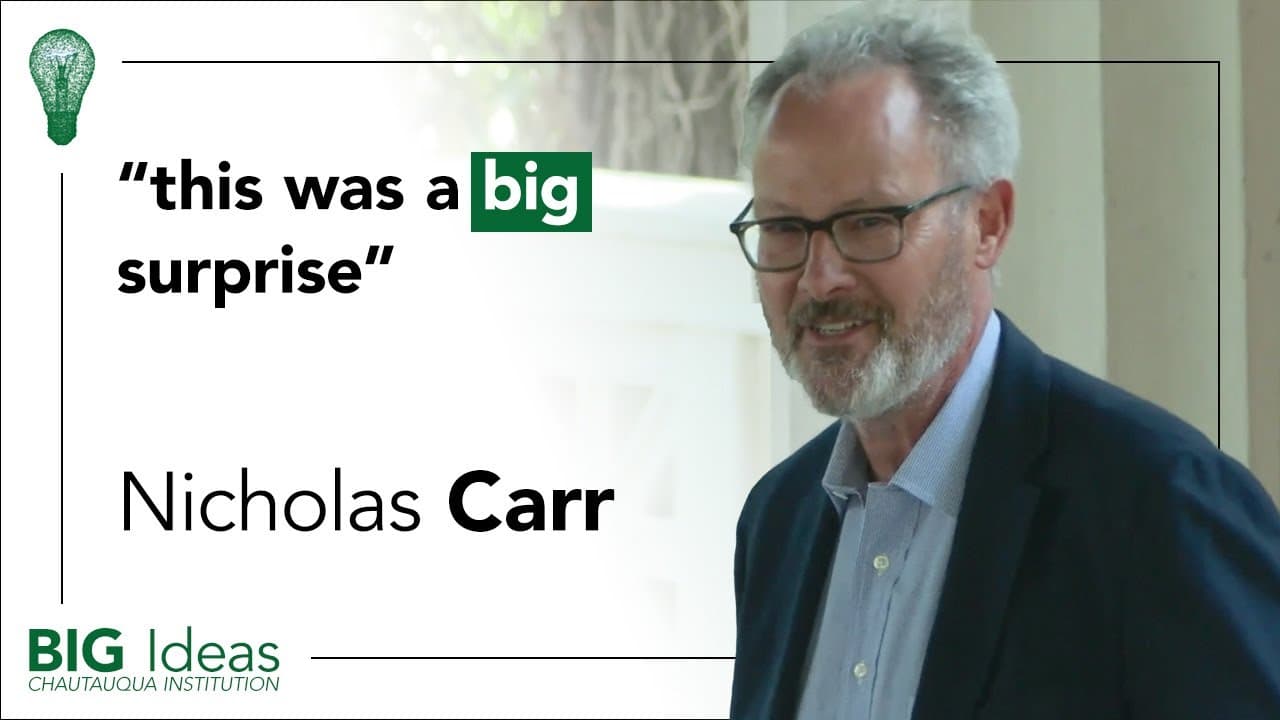
About Nicholas Carr
Nicholas Carr examines what technology does to our thoughts, skills and lives. His essays, including "Is Google Making Us Stupid?" in The Atlantic, have been collected in anthologies such as The Best American Science and Nature Writing. He has appeared on NPR's All Things Considered, the PBS NewsHour, CBS Sunday Morning and The Colbert Report.
Carr's argument runs against a comfortable assumption. "We as humanity have made an error that we've been largely unaware of," he explains. "We've come to apply the goals and measures of industrialization to very human activities like how we communicate with one another." Today's superabundance of messages, he argues, breeds misunderstanding rather than understanding, strife rather than harmony. Among his proposed guardrails is frictional design: "Think of speed bumps on a road, they're used to slow traffic down for greater safety. Similarly, a waiting period on publishing a social media post could give the poster time to reconsider their words."
Nicholas's Keynote Topics
Communication today would have looked like magic less than 50 years ago – we’re now able to communicate instantly with nearly everybody at once thanks to modern technology. We want to believe that more communication is always better, but have these breakthroughs actually caused more harm than good? According to acclaimed author, sociologist and researcher Nicholas Carr, today’s superabundance of messages breeds misunderstanding rather than understanding, strife rather than harmony. In this eye-opening presentation, Carr draws on his latest book, “Superbloom: How Technologies of Connection Tear Us Apart,” to show why, starting as far back as the telegraph, humans have struggled to put controls on the speed of communication. Examining why instant communication appeals to our deepest instincts even as it undermines social relationships, Carr gives attendees a new lens for viewing how technology impacts how we talk to each other and how we see the world. Audiences will gain new insight into the importance of thoughtful messaging and how potential guardrails such as frictional design can force us to slow down and consider if speed and efficiency in communication really is the best solution.
Today we can communicate with a speed that’s never been seen before. Whether it’s sending a message to your colleague in the office next door or to a group of executives at the company headquarters on the other side of the world, is being able to instantly message at scale more harmful than helpful? According to award-winning author, sociologist and researcher Nicholas Carr, today’s overreliance on technologies like social media and AI undermines our ability to think critically and communicate clearly. In this revealing presentation, Carr draws on his acclaimed books, “The Shallows: What the Internet Is Doing to Our Brains,” “The Glass Cage: How Our Computers Are Changing Us,” and “Superbloom: How Technologies of Connection Tear Us Apart” (2025), to provide both historical context and modern lessons about how digital technologies, especially media, have hampered our thinking and communication skills. By better understanding the unanticipated effects of the never-before-seen efficiency of how we interact, audiences will be empowered to help shape a more constructive digital future where in-person collaboration is still a prominent feature.
For decades, technology has been helping humans perform tasks, taking the drudgery out of work, enhancing productivity and, in some cases, eliminating the need for people to be involved at all. But automation has a dark side. When pursued rashly, it can undermine human performance, erode the subtlest of human talents and put an organization’s future at risk. During this thought-provoking presentation, New York Times bestselling author and former Harvard Business Review executive editor Nicholas Carr – author of “The Shallows” and the Wall Street Journal essay “Automation Makes Us Dumb” – encourages organizational leaders to pause before offloading too many tasks to robots and AI. Drawing on decades of research, he explains how automation is reshaping work in every sector, including professional and white-collar jobs long considered the special preserve of humans. He will explore automation’s hidden and sometimes disastrous psychological effects. And he will lay out a practical new approach to the design of automation systems that ensures we get the best out of people as well as machines.
Is technology rotting our brains and is it too late to do anything about it? In this fascinating presentation, New York Times bestselling author Nicholas Carr examines the intellectual and social consequences of smartphones, social media and the internet in general. Drawing on a rich array of scientific evidence, Carr explains how our devotion to screens is taking a profound toll on our analytical and problem-solving skills, our ability to think deeply and creatively, and even our social and emotional lives. He explores how organizations can sabotage themselves when they require ceaseless screen time and device-monitoring. Weaving insights from his bestselling books on the intersection of tech and sociology, as well his Wall Street Journal essay, “How Smartphones Hijack Our Minds,” Carr helps participants re-think their technology habits. Audiences will be empowered to become more conscious and productive people at work and at home, allowing them to set a course toward a different and better future.
Books by Nicholas Carr

Superbloom: How Technologies of Connection Tear Us Apart
W. W. Norton & Company, 2025
The Shallows: What the Internet Is Doing to Our Brains
W. W. Norton & Company; Updated edition, 2020
Utopia is Creepy and Other Provocations
W.W. Norton & Company, 2016
The Glass Cage: How Our Computers Are Changing Us
W.W. Norton & Company, 2015
The Big Switch: Rewiring the World, From Edison to Google
W.W. Norton & Company, 2008
Does IT Matter?
Harvard Business Review Press, 2004Nicholas in the Media

The War Against Friction with Nicholas Carr

Nicholas Carr on Building Attention in a Digital Age

What Happens When AI-Generated Lies Are More Compelling than the Truth?

Who Can Save Us From Social Media? At This Point, Perhaps Just Us.

The Tyranny of Now
All the Little Data
Don’t Wait for Silver Bullets for Social Media Reform ($)
Beautiful Lies: The Art of the Deep Fake
How to Fix Social Media ($)
What the Silicon Valley Idealists Got Wrong
10 Books About Tech for Every Kind of Person in Your Life
Why Barack Obama Wants You to Read This Book About the Internet
The Spanish Council of Psychology, the leader of psychology in the Ibero-American world, held its annual conference (virtually) on November 14, 2020 featuring well-known author and lecturer Nicholas Carr who spoke about the mind and social networks. His inclusion on the list of speakers for our conference was without a doubt the main incentive to register and participate in the conference and was a large part of the conference’s success.
Rodolfo Ramos ÁlvarezProfessor Psychology / Technology, General Council of Psychology of Spain
Bring Nicholas to your next event
Tell us about your event and we will be in touch right away.


