

Iyad Rahwan served on the study panel for the 2026 AI100 report, released Nov. 10 by the Stanford University-based One Hundred Year Study on Artificial Intelligence. The report, titled AI Goes Mainstream: The Scaling Era and the Rise of Generative AI, examines how artificial intelligence has evolved since the study’s 2021 report. The Max Planck Society published an interview with Rahwan about the findings the same day, and the Max Planck Institute for Human Development posted a video in which he reflects on the report.
The AI100 study convenes experts every five years to assess the state of artificial intelligence and its impact on society. Rahwan told the Max Planck Society that the 2021 report “was very positive about the potential for rapid AI development. Yet it failed to anticipate what became known as the ‘ChatGPT moment’ that took the world by storm.” He described the past five years as the “Scaling Era,” defined by the discovery that making AI systems larger and training them on more data produces qualitatively new capabilities. “In the past, AI scientists thought we needed new scientific insights in order to build smarter machines,” Rahwan said. “But during the ‘Scaling Era,’ AI scientists realized they just needed to scale up existing ideas.”
The concentration of AI power
Rahwan identified the concentration of power as the most concerning development in the report. “If the entire world runs on a handful of very powerful AI systems, controlled by a handful of companies in one or two countries, then just a few people have a massive amount of influence,” he said. The report shows that computing capacity, talent and resources are concentrated in a small number of companies and countries, which Rahwan described as both an economic and a political challenge.
Rahwan argued that the moment is urgent for Europe. “If Europe fails to keep pace in the race toward frontier AI, it may face an existential challenge to its sovereignty and way of life,” he told the Max Planck Society. “Europe should seize this ‘Sputnik moment’ and invest heavily to retain and develop its AI talent and build the commercial ecosystem for a sovereign ‘made in Europe’ AI infrastructure.”
AI as an agent, not just a tool
Rahwan also addressed what he sees as a widespread misconception: that AI is only a tool. “AI is also becoming an agent,” he said. “As billions of people interact with AI, it can perceive the world through those interactions and, in turn, itself act in the world through the people who use it.” He described AI as having “a form of collective agency that emerges through its interactions with people.”
Rahwan said he expects AI to usher in a new era of scientific discovery. “The pace of scientific research will be massively accelerated,” he said. He cited his own lab’s work on making AI more scientifically creative, as well as research showing that AI can write high-quality reviews of scientific papers.
About Iyad Rahwan
Rahwan is director of the Center for Humans and Machines at the Max Planck Institute for Human Development in Berlin. His 2019 paper in Nature, Machine Behaviour, argued that intelligent machines should be studied the way social scientists study people. He co-authored the 2025 United Nations Development Programme report The Next Great Divergence: Why AI May Widen Inequality Between Countries. He also received the 2025 Lagrange-Fondazione CRT Prize for his research on social interaction between humans and machines. Until 2020, he was an associate professor of media arts and sciences at the MIT Media Lab.
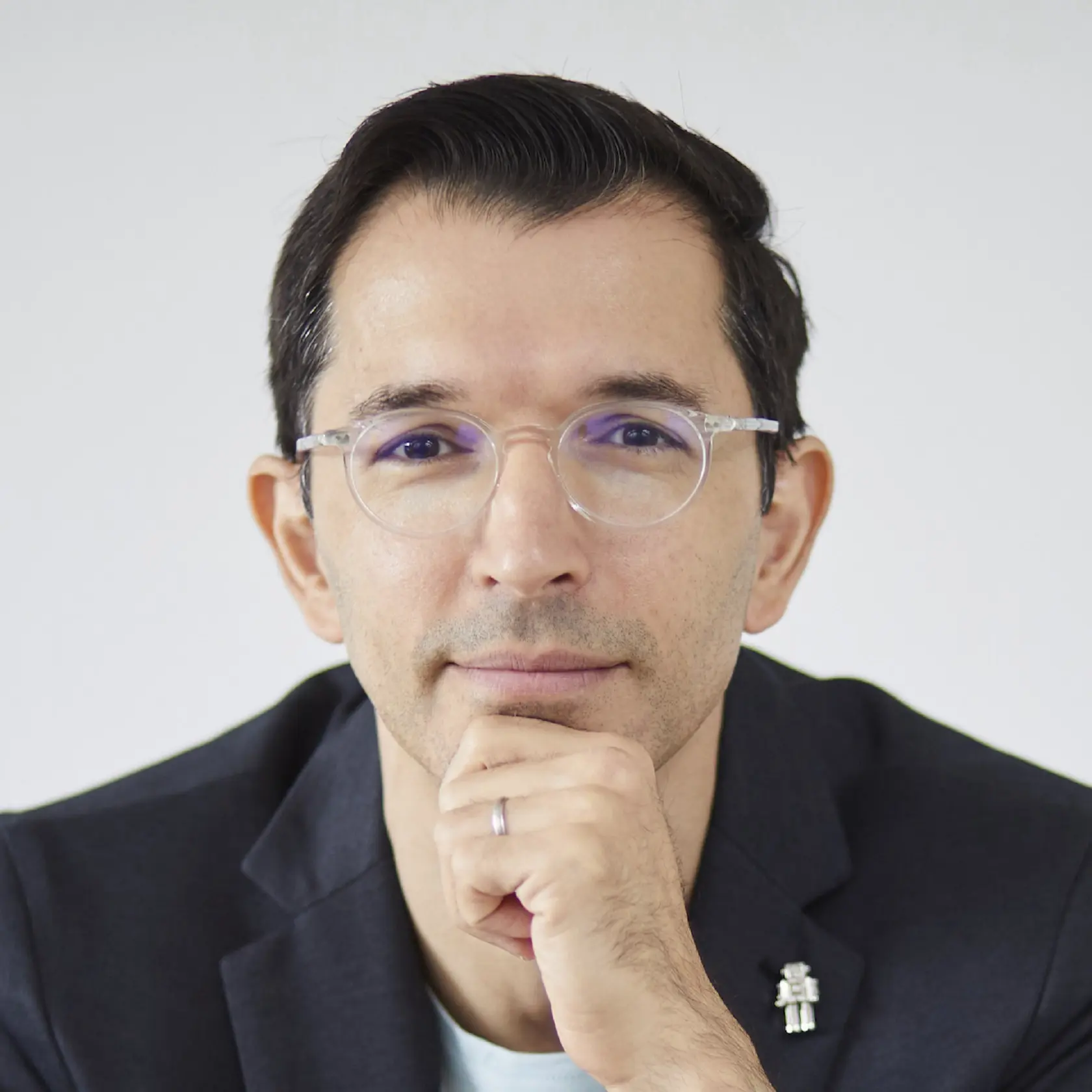
Iyad Rahwan is exclusively represented by Stellant Group for speaking engagements including keynotes, fireside chats and panel discussions with leadership teams thinking through how AI will reshape work, scientific discovery and the concentration of technological power. For our consulting or advisory offerings, please reach out for a custom proposal.


