

Watch Cass in Action
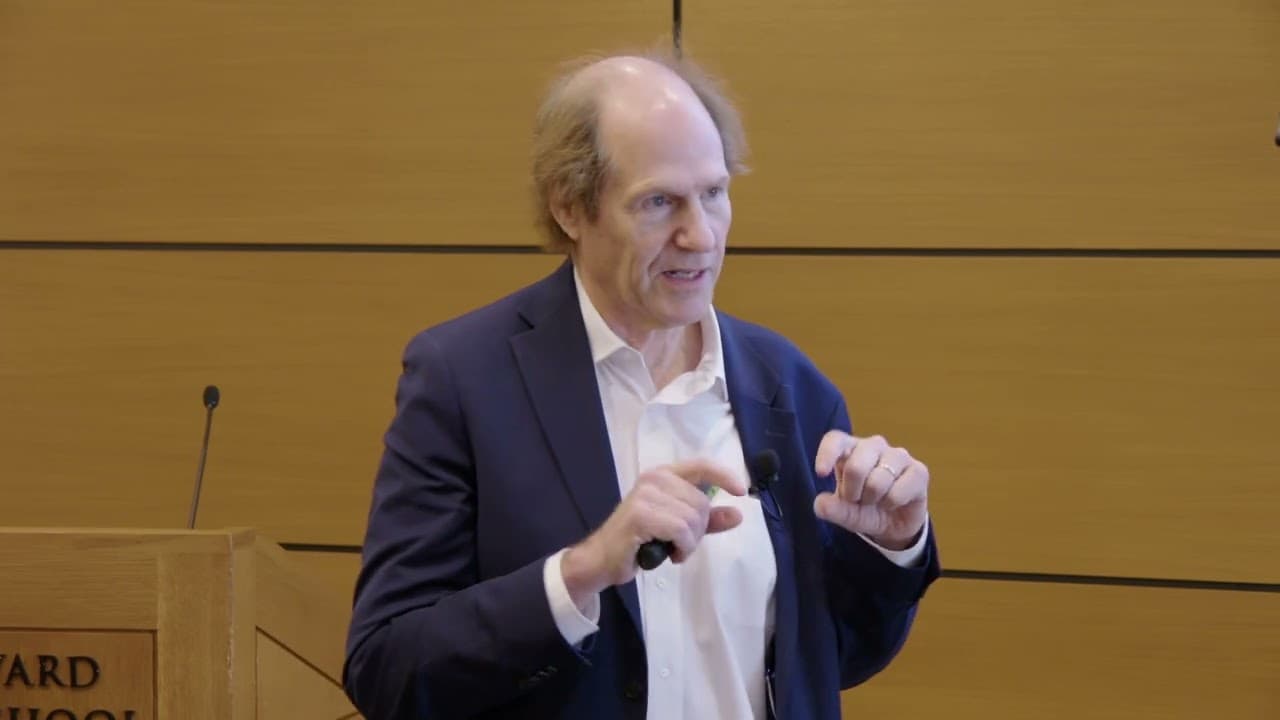
About Cass Sunstein
Cass Sunstein has advised the United Nations, the European Commission, the World Bank and the United Kingdom's Behavioural Insights Team. "Core commonalities, like how people dislike losses more than they like gains or why people all over the world make the same mistakes about risk, are at the core of our species," he says.
He has lately turned to algorithms and AI, examining how they can improve human judgment. "What's also interesting is what algorithms can't do, like predict romantic attraction or if a joke will land," he notes.
Cass's Keynote Topics
It’s hard to imagine our world without its stars, icons, influencers and celebrities – the rich and famous that flood our media. They’re part of our culture and history, seeming permanent and preordained. That’s far from the case, as Harvard Law professor Cass Sunstein shows in his book “How to Become Famous.” Focusing on both famous and forgotten (or simply overlooked) artists and luminaries in music, literature, business, science, politics and other fields, he explores why some individuals become famous and others don’t and offers a new understanding of the roles played by greatness, luck and contingency in the achievement of fame. With lessons for marketers, executives and leaders alike, Sunstein examines recent research on informational cascades, network effects and group polarization to probe the question of how people become famous. He leads audiences on a fun, captivating and at times profound journey that will forever change your perspective on the latest celebrity’s “fifteen minutes of fame” and on what vaults some to the top — and leaves others in the dust.
While polarization is an age-old problem, managing and governing people in the 21st century has been complicated by increasingly divisive rhetoric within online and in-person groups, creating damaging political and social divisions in every corner of the world. Business and government leaders looking for successful ways to bridge those divides will find Harvard Law School professor Cass Sunstein’s insights invaluable. In this presentation, he shares the results of experiments he’s conducted, which explain why such divides exist. He then outlines methods leaders can employ to promote unity, understanding and, ultimately, a successful way forward to solve common problems and reach common goals.
Have you ever noticed that what is thrilling on Monday tends to become boring on Friday? Even exciting events and objects lose their sparkle after a while. People stop noticing what is most wonderful in their own lives, and they also stop noticing what is terrible – they get used to dirty air, stay in unhealthy relationships, grow to accept authoritarianism and take foolish risks. But, asks Harvard Law professor Cass Sunstein, what if we could find a way to see everything anew and regain sensitivity, not only to the great things in your life, but also to the terrible things you stopped noticing and so you don’t try to change? In a groundbreaking study, encapsulated in his book “Look Again,” Sunstein and his co-author investigate why we stop noticing both the great and not-so-great things around us and how to “dishabituate” at the office, in the bedroom, at the store, on social media and in the voting booth. Based on decades of research in the psychological and biological sciences, he illuminates how to refresh your perspective, allowing you to more clearly identify the bad, and more deeply appreciate the good.
Human beings are sometimes “biased,” in the sense that they make systemic mistakes (for example, they might show “optimistic bias”). In addition, human beings are sometimes “noisy,” in the sense that they show unwanted variability (perhaps making different decisions in the morning and the afternoon). The best solution to both noise and bias, says Harvard Law School professor Cass Sunstein, comes from “decision hygiene,” which can include the use of formal models and algorithms. In this presentation based on his award-winning book “Noise: A Flaw in Human Judgement” (2021), Sunstein illuminates concrete ways to reduce or even eliminate widespread “algorithm aversion.”
Generative AI has led to the definition of “sentience” becoming more of a question than a statement. If AI tools can “think,” should they have rights? No more than your toaster should have rights, says Harvard Law professor Cass Sunstein, a prominent legal scholar and well-known authority on the U.S. Constitution. Funny and engaging, Sunstein uses accessible metaphors and pop culture references to illustrate what generative AI is, how it works and why, even though it seems humanlike in its interactions, it doesn’t deserve any more rights than a blanket on a bed. Sunstein brings organizations thought-provoking questions that encourage deeper thinking about how to engage with AI technology, no matter how quickly it advances.
Books by Cass Sunstein

Animals Matter: The Case for a Kinder World
Princeton University Press, January 2027
The Price of Happiness: Behavioral Economics and Willingness to Pay
Cambridge University Press, August 2026
Decisions and Social Norms
Edward Elgar Publishing, 2026
Separation of Powers: How to Preserve Liberty in Troubled Times
The MIT Press, 2026
Algorithmic Harm: Protecting People in the Age of Artificial Intelligence
Oxford University Press, 2025
Climate Justice: What Rich Nations Owe the World―and the Future
The MIT Press, 2025
Imperfect Oracle: What AI Can and Cannot Do
The American Philosophical Society Press, 2025
Manipulation: What It Is, Why It's Bad, What to Do About It
Cambridge University Press, 2025
On Liberalism: In Defense of Freedom
The MIT Press, 2025
Campus Free Speech: A Pocket Guide
Harvard University Press, 2024
How to Become Famous: Lost Einsteins, Forgotten Superstars, and How the Beatles Came to Be
Harvard Business Review Press, 2024
Look Again: The Power of Noticing What Was Always There
Atria/One Signal Publishers, 2024
Decisions About Decisions: Practical Reason in Ordinary Life
Cambridge University Press, 2023
Default Nudges: From People's Experiences to Policymaking Implications
Palgrave Macmillan, 2023
How to Interpret the Constitution
Princeton University Press, 2023
Bounded Rationality: Heuristics, Judgment, and Public Policy
MIT Press, 2022
Averting Catastrophe: Decision Theory for COVID-19, Climate Change, and Potential Disasters of All Kinds
NYU Press, 2021
Liars: Falsehoods and Free Speech in an Age of Deception
Oxford University Press, 2021
Noise: A Flaw in Human Judgment (Winner of the 2021 getAbstract International Book Award)
Little, Brown Spark, 2021
Nudge: The Final Edition
Yale University Press, 2021
Sludge: What Stops Us from Getting Things Done and What to Do About It
MIT Press, 2021
This Is Not Normal: The Politics of Everyday Expectations
Yale University Press, 2021
Too Much Information: Understanding What You Don't Want to Know
The MIT Press, 2020
Conformity: The Power of Social Influences
2019Articles by Cass Sunstein
On not being "Trapped in Amber"
September 2026SSRNOn The Flawed Architecture Of Expert Evidence
August 2026SSRNPaternalism and Autonomy
June 2026SSRNNon-User Externalities
May 2026Big ThinkHow the U.S. Constitution Protects Liberty From the Powerful’s Dark Impulses
March 2026The HillThe 6 Separations of Power, and Why They All Matter
February 2026The HillWhy Democrats Keep Losing: Too Many Baptists, Not Enough Bootleggers
August 2025The GuardianWhy We Need a Right Not to Be Manipulated
July 2025The Washington PostThis Book Could Change the Way Conservatives Read The Constitution
September 2024The New York TimesWhy People Fail to Notice Horrors Around Them
February 2024TIMEYour Life Is Better Than You Think
February 2024The New York TimesWhy I Am a Liberal
November 2023Cass in the Media

Harvard Law Professor Cass Sunstein proposes seven steps toward constitutional ‘refounding’

Six Ways the Constitution Keeps Leaders in Check

Burkeans, Nutcases and Originalists

10 Must-Read Tech Books of 2025

‘Imperfect Oracle’ Review: A Question of Autonomy

Konvitz Lecturer Calls for ‘Curious, Teeming and Occasionally Noisy Pluralism’
Taking AI Ignorance Seriously

On Liberalism: In Defense of Freedom
We Need a Liberalism for Our Time

Is American Still a Liberal Nation?
How to Get Kids to Give Up Social Media on Their Own

You're Being Manipulated: Here's How to Fight Back
How should we choose when our values might change as a result of our choice? Or when we have limited time to assess the options? How should we decide what we want to learn and what we ought to believe? In 'Decisions about Decisions', Sunstein presents a rich and diverse set of reflections on these and other questions about how we do, and should, decide how to make the choices that fill our lives. The prose is clear and engaging; the essays packed with illuminating and accessible examples; the thought deeply informed throughout by Sunstein’s broad knowledge of behavioral economics, public policy, legal theory, and philosophy.
Richard PettigrewUniversity of Bristol
Bring Cass to your next event
Tell us about your event and we will be in touch right away.


