

Watch Michael in Action
About Michael Horn
Why are people changing jobs so frequently, and what can organizations do about it? Research cited by Michael B. Horn suggests that one in 16 workers, more than 100 million people worldwide, may have to switch occupations by 2030. Horn teaches leaders in every sector how to recruit, train and retain people who can continually learn new technologies and skills.
His book Job Moves, co-authored with Bob Moesta, draws on research with more than a thousand professionals to adapt the Jobs to Be Done theory to careers. The finding: progress is not a ladder. When employees change jobs, they want to get away from their current reality, take the next steps in their careers, regain control, or reengage with their work. "The employment game is so often a matching problem between employers and candidates," Horn explains. He has worked closely with Fortune 1000 employers on upskilling and reskilling.
Michael's Keynote Topics
AI represents a potentially disruptive technology — the kernel around which major disruptive innovations that reinvent whole systems can be built. But just because it represents such an inflection doesn’t mean AI will be used that way, says Michael Horn, pioneering digital learning strategist focused on securing the future of businesses and award-winning author of five books on the future of learning. Each education organization — each school, college, university — now confronts a choice. In this presentation, Horn reveals how organizations can implement AI as a sustaining innovation to improve what they do currently, or implement it in a new business or organizational model to launch a disruptive innovation. Or they can deploy a dual transformation strategy and do both. The key is recognizing the importance of building new models around the AI, not assuming that the technology alone represents a silver bullet.
How do colleges and universities stay relevant and a favored pathway for students in a rapidly changing educational landscape? Michael B. Horn, a pioneering digital learning strategist, says institutions need to understand what drives both excitement and anxiety for their students on campus, allowing them to design more responsive experiences that will attract incoming learners. Drawing from his book, “Choosing College,” Horn examines the forces behind students’ educational choices today. Backed by years of research, he explores the shift toward microcredentialing, its potential impact on higher ed, students’ rising demands for a return on investment in education, and how institutions can respond to these trends. Horn provides insights on aligning educational offerings with the evolving needs of students and employers to prepare universities and leaders to not only respond to current demands, but also to see around corners and anticipate future educational needs.
More challenges are facing colleges and universities than at perhaps any time in recent memory. From public perception and financial sustainability for some to mergers and acquisitions and from online learning, ROI and cost, and student debt to free speech, athletics and much more, higher education institutions are facing enormous pressures. Navigating them requires an understanding of which pressures could prove existential—and which could create opportunities for innovation and thriving. There are no one-size-fits-all answers as different colleges sit in different circumstances. Michael B. Horn, an award-winning author of six books on the future of work and learning, including the national bestseller “Job Moves: 9 Steps for Making Progress in Your Career,” offers college leaders a way to navigate the different paths to help them create value for those they serve no matter which future they follow.
In today’s education landscape, colleges are struggling to meet the needs of students as well as businesses facing shortages of skilled workers. There’s a growing sense that a degree is no longer worth the time, money and effort. So how can higher education institutions transform their model into something that works for everyone in the 21st century? In this presentation, Michael Horn – a leading authority on the future of work and education – outlines ways colleges and universities can gain a competitive edge and thrive. Since no two institutions are exactly alike, Horn helps participants evaluate gaps between the desired goals of their organization and existing efforts so they can develop and implement a nimble, discovery-driven path toward success that requires the least amount of capital investment.
According to reskilling and upskilling expert Michael B. Horn, an astounding 1 billion people switch jobs each year and the quest for job satisfaction remains largely unfulfilled. Why is this career carousel spinning so quickly, and how can organizations attract and retain the talent they need? Horn’s insightful book “Job Moves” draws from extensive research and the innovative “Jobs to Be Done” theory to present a new approach to understanding job changes from both the leader and the employee perspectives. He challenges conventional recruitment strategies and emphasizes a more nuanced, individual-centric perspective on career development. Through Horn’s expertise, business leaders will discover how to effectively navigate the intricacies of the modern job market, ensuring their organizations become havens for talent development and retention. Engaging, surprisingly funny and equipped with practical strategies that leaders can put into place right away, Horn’s methodologies show leaders how their organizations can thrive by redefining what it means to progress in one’s life and career.
Digital learning tools are increasingly prevalent—and many are pushing back on their use in schools. That means the question and challenge facing schools should be: if we use edtech, how do we integrate it thoughtfully to make a real impact? The answer lies not in focusing on the technology, but focusing first and foremost on the learning model, says Michael B. Horn, an influential voice in educational innovation. The author of “Blended: Using Disruptive Innovation to Improve Schools, Horn discusses how schools can harness technology to enhance learning environments effectively. An engaging, down-to-earth speaker, he unpacks strategies for redesigning classrooms to foster the durable, positive use of technology that supports educators and students.
Policies that create access to online learning are outpacing policies that transform the system and focus on learning outcomes. The focus on outcomes is a positive trend – it makes sense to pay providers not just for serving students but also for student performance. But we must also eliminate the input-focused rules that dictate how school leaders accomplish these goals, says digital learning strategist Michael Horn, a leading authority on the future of work and education. In this presentation, he examines policies that need to be struck down – from those dictating student-to-teacher ratios, teacher certification requirements or rules governing seat time. He then outlines a framework that will allow institutions and educators to position future generations for success.
Learning gaps and unique individual needs have always been there for students, but this decade’s sudden mass shift to remote learning laid bare just how widespread those gaps and needs are. Though online schooling gives learners options and allows for more students to be reached, they need access to computers and Wi-Fi to take advantage of the opportunities it presents. In this presentation, digital learning strategist Michael Horn – a leading authority on the future of work and education – discusses the lessons learned by remote learning and why we need an equitable system that ensures all students have access to online schooling. He also outlines valuable digital learning tools and explains why the future of education must include online options.
Many companies have adopted digital solutions by investing in robots, technology and automation to increase productivity. While that initially negatively affected a segment of workers, digital learning strategist Michael Horn – a leading authority on the future of work and education – takes an optimistic long-term view. An advisor at Guild Education, Horn has worked closely with Fortune 1000 employers as Guild helps them facilitate upskilling and reskilling to secure jobs, as well as the company’s future. In this presentation, he explains why (contrary to popular myths) robots will NOT be stealing our jobs, how the future of work will cast humans and robots as co-workers, and how organizations can make the most of opportunities using these tools.
Books by Michael Horn

Job Moves: 9 Steps for Making Progress in Your Career
Harper Business, 2024
From Reopen to Reinvent: (Re)Creating School for Every Child
Jossey-Bass, 2022
Choosing College: How to Make Better Learning Decisions Throughout Your Life
Jossey-Bass, 2019
The Blended Workbook: Learning to Design the Schools of our Future
Jossey-Bass, 2017
Blended: Using Disruptive Innovation to Improve Schools
Jossey-Bass, 2014
Private Enterprise and Public Education
Teachers College Press, 2013
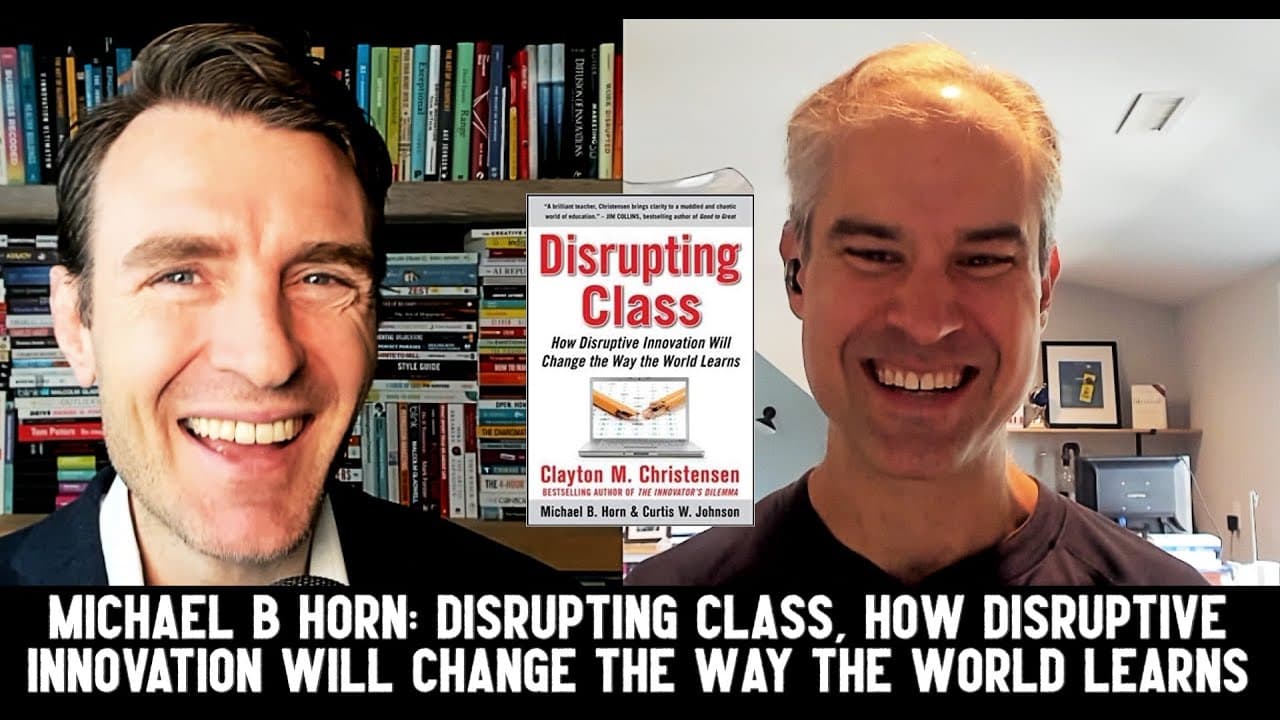
Disrupting Class, Expanded Edition: How Disruptive Innovation Will Change the Way the World Learns
McGraw-Hill, 2010Articles by Michael Horn
A New Accountability Model For Alternative K-12 Schools
2021EIU Microsoft EducationBridging the Digital Divide to Engage Students in Higher Education
2020CorpUAugmented Management Intelligence: Can Robots Bring Humanity Back to the Workplace?
2017Entangled SolutionsThe Future of Student Aid: Advancing New Models to Expand Access, Improve Quality, and Spur Innovation in Education
2017Christensen InstituteA Blueprint of Breakthroughs: Federally Funded Education Research in 2016 and Beyond
2016The Clayton Christensen Institute for Disruptive InnovationDisrupting Law School: How Disruptive Innovation Will Revolutionize The Legal World
2016American Enterprise InstituteMoving Beyond College: Rethinking Higher Education Regulation for an Unbundled World
2015The Brookings InstituteSchools as Community Hubs: Integrating Support Services to Drive Educational Outcomes
2015The Clayton Christensen Institute for Disruptive InnovationThe Educator's Dilemma: When and How Schools Should Embrace Poverty Relief
2015The Clayton Christensen Institute for Disruptive InnovationIs K-12 Blended Learning Disruptive? An Introduction of the Theory of Hybrids
2013Innosight InstituteDisrupting College: How Disruptive Innovation Can Deliver Quality and Affordability to Postsecondary Education
2011Innosight InstituteThe Rise of K-12 Blended Learning
2011Michael in the Media

Michael Horn's Podcast, Class Disrupted

The Big Flaw With Ed-Tech Tutoring Isn’t Technological

Unlocking Educational Potential: The Rise and Future of Microschools with Michael Horn

Rethinking disruption
AI in K–12: A New Year Reality Check for School Leaders

Students Are Anxious About the Future With A.I. Their Parents Are, Too

How Recent Grads Can Get a Job—Even in a Challenging Labor Market

The Secret to Retaining the Best Employees: Ask Them These Four Questions

Can Elite Universities Remain Global? ($)
AI-Powered Tools May Make It Even Harder to Find a Job
School Reinvention in Practice
Highlights Take 2: Future-Proof Your Career
In offering 21st century advice in ‘Choosing College’ to students and parents about what to seek in a college experience, Michael Horn and Bob Moesta also lead counselors, teachers, and higher education leaders to examine what they are offering today’s applicants. Introducing “The Jobs to be Done” concept is a practical guide for sparking reflection, relevance, and renewal across the teaching and learning spectrum. I found how Horn and Moesta provide personal human stories on top of extensive data to be extremely effective driving home key points. This book provides an engaging approach to students and parents making critical decisions about college; even better, it pushes higher education leaders to make decisions that will sharpen their institution’s relevance to learners with different needs. And for policymakers confronting tough decisions about higher education, ‘Choosing College’ is a good starting point for matching how well a state’s institutions are meeting today’s student and workforce needs.
Bob WiseFormer Governor of West Virginia and Congressman
’Choosing College’ tackles one of the most complex and foundational decisions facing society today. Michael Horn and Bob Moesta go beyond dissecting the decision and formulating a return-on-investment. They frame a systemic approach to assist the reader in making a customized decision that is best for every individual. The break-through approach is the application of the popular innovation methodology (jobs-to-be-done) as a means of providing the reader with a pragmatic step-by-step model to make the most informed choices for their unique situation. As a business leader, an education advocate and a father, I found myself completely immersed in the content and in the resolution. I highly recommend this book to anyone contemplating the value and choices of pursuing continuing education.
Brad D. SmithExecutive Chairman, Intuit Inc.
Michael captivated Indiana educators, business leaders, and community members at the IACTE Summit November 7 – 8, 2019. Michael’s thought-provoking and innovative presentation gave all of us something to think about as it relates to creating new educational models, coaching educators, and transparency vs. accountability. Although Michael shared challenges, he also shared some innovative practices and solutions that were well received in Indiana. More people need to hear and learn from Michael B. Horn.
Fran BisselleHead of School, Hathaway Brown
Michael is a pro when it comes to how technology is shaping the future of PK-12 education. As a speaker, he does his homework, he is easy to work with, he manages technology with ease and he responds to audience questions thoughtfully. He was well received as both a keynote speaker and webinar thought leader. We look forward to working with him again in the future.
Jeffrey ShieldsPresident and CEO, NBOA
Bring Michael to your next event
Tell us about your event and we will be in touch right away.


