

Watch Nick in Action

About Nick Romeo
Nick Romeo has spent years covering the world's most innovative economic and policy ideas. "Most economics is just political philosophy with a veneer of science and numerical wizardry to shut down further discussion," he says. "There's a pretty widespread awareness that the current status quo is not working."
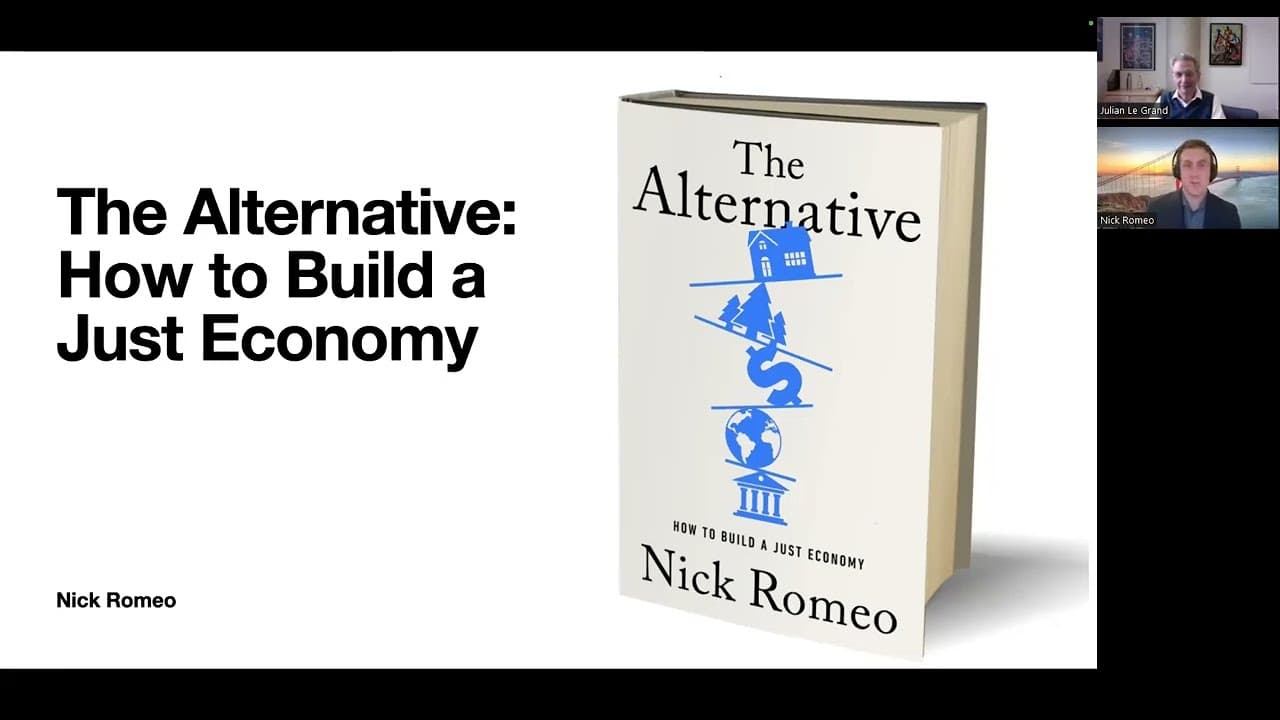
In his debut book, The Alternative: How to Build a Just Economy, Romeo traveled across Europe and the United States to document businesses, municipalities and countries restructuring their economies in practical ways. He profiles Spain's Mondragon, the world's largest cooperative, with roughly 72,000 employees, more than $12 billion in annual revenue and a fixed 6:1 ratio between executive and worker pay. He examines the world's first job guarantee program in a town outside Vienna, the growing use of perpetual purpose trusts to keep companies bound to their founding values, and participatory budgeting in Cascais, Portugal, where residents decide directly how municipal money is spent.
Nick's Keynote Topics
What is the true cost of bread, hamburgers, chocolate, coffee, smart phones, international air travel and everything else our economies produce? Nick Romeo, economic journalist, and author of the book, “The Alternative: How to Build a Just Economy” (2024), says any reasonable answer requires both empirical research and philosophical debate. Many consumer goods have cheap prices, but at the cost of environmentally damaging production processes and abusive labor practices. Drawing on his in-depth New Yorker feature on true pricing, Romeo presents an emerging framework developed by researchers in the Netherlands which provides standardized principles for calculating the true prices of goods. Audiences will learn how true prices are calculated, what assumptions are made by different models and how true prices have the potential to transform our economies, reduce human suffering and protect the natural world.
To say that workers today deserve to earn enough to afford the basic necessities of life is no longer controversial, and a growing number of businesses of all sizes are making public commitments to pay workers a living wage. However, according to Nick Romeo, economics journalist and author of the book, “The Alternative: How to Build a Just Economy” (2024), one stumbling block is that there isn’t universal agreement on what defines a living wage in the first place. In this eye-opening presentation based on his detailed New York Times article on living wages, Romeo will show how the most influential living wage calculators of today are using far less generous definitions of what constitutes a living wage than those from 100 years ago when the concept originated. Digging deeper, he’ll reveal how many of today’s calculations exclude vital factors like saving for unexpected events and even simple pleasures like occasional meals out and vacation time. Audiences will be empowered to tackle the question of what it would take to reform our concept of living wages for today and how to persuade businesses to pay true living wages.
What would happen if any person who wanted to work was guaranteed a rewarding job with decent pay? In an age of increasing automation and deindustrialization, job guarantees are poised to become an increasingly important policy tool, says Nick Romeo, economics journalist and author of the book, “The Alternative: How to Build a Just Economy” (2024). In this revealing presentation, he’ll share the story of a town just outside Vienna, Austria that has implemented a job guarantee program that is being closely watched by economists and policymakers around the world. Drawing on first-person stories from program participants and his influential New Yorker story, Romeo gives an in-depth analysis of the job guarantee pilot program, zooming in on the important distinction that must be made between universal basic income (UBI) programs and job guarantee programs. He helps audiences recognize that even with enough money, many people still value the structure and community provided by a meaningful and useful job. Participants will not only gain a view of current models of job guarantee programs of varying scales throughout the world, but an understanding of how they can make it happen in their community, too.
Worker-owned cooperatives are often dismissed as small, inefficient and idealistic. In fact, they can be just the opposite, supporting both a thriving business and the broader community, says renowned journalist Nick Romeo. In this myth-busting presentation, he presents the case of the Mondragon cooperatives of northern Spain, an organization that employs roughly 80,000 people and generates $12.2 billion in annual revenue. With a fixed ratio between worker salaries and executive salaries of 6:1, he explains how Mondragon’s profit-sharing with workers and strict executive compensation limits has made it a flourishing, dynamic and internationally competitive network of businesses. Audiences walk away with a better understanding of the inner workings of Mondragon’s business philosophy and how it can serve as a model to organizations around the world.
In a time when uncertainty feels like the dominant tone around the world, economics journalist and author Nick Romeo draws from his book, “The Alternative: How to Build a Just Economy” (2024) to share stories of successful economic programs on display around the world, making the case for an optimistic outlook on the future. In this encouraging presentation, he’ll use real-world examples of successful programs such as the world’s first job guarantee in a small town in Austria and Spain’s largest worker-owned cooperative. He reveals how a growing number of companies are using perpetual purpose trusts to combat wealth inequality and create a more humane and sustainable model of capitalism. Audiences will gain a deeper understanding of the motives of the people who are making these positive changes, what their struggles are and what we can all do to contribute to the flourishing of these meaningful ideas that can benefit businesses, governments and society as a whole.
The process of decision making at the government level has become more opaque than ever. At a moment of historic distrust in institutions and erosion of democratic norms, how can people regain agency in the democratic process? In this engaging presentation, renowned journalist Nick Romeo describes the spread of participatory budgeting, a radically direct form of democracy in which people decide how their tax money is spent. He’ll present the real-world example of Cascais, Portugal, where citizens gather at public meetings to discuss how to spend the municipal budget, a process traditionally surrendered to politicians. He’ll break down the participatory budgeting process in Cascais in which firefighters lobby for better trucks, middle schoolers pitch a new skate park and Wi-Fi at bus stops, and nurses ask for a fleet of vans to help with hospice care. In a practice that is increasingly becoming an important part of urban politics, especially in Europe, residents become ultra-engaged through debating measures and seeing the most popular proposals, if they pass a feasibility study, become funded and implemented within three years. Through extensive research, storytelling, practical examples and tips from the process in Cascais, audiences will gain insight into the power of participatory budgeting and will learn how governments and organizations can adopt the model for themselves.
The wealth inequality gap is growing at an unprecedented rate. However, says renowned economic journalist Nick Romeo, an increasing number of financial leaders and investment funds are working to close the divide by prioritizing an unexpected new strategy: the cooperative takeover. In this revealing presentation, he outlines the framework in which funds buy businesses on the point of transition, then convert them into some form of employee-ownership, sharing equity with the workers who help create it in the first place. Participants will understand how and why this tool is one of the most direct and impactful ways for investors to decrease wealth inequality. In addition, audiences will learn how cooperative takeovers also have the potential to empower ESG initiatives to deliver on ambitious promises.
When business owners retire, it’s often difficult to ensure an organization maintains its founding values. As renowned economic journalist Nick Romeo’s research has revealed, more leaders are preparing well in advance to guarantee their values will remain long after their time at the helm has ended. In this eye-opening presentation, he explains how a growing number of retiring founders – as well as younger business owners – are transferring ownership of their businesses to a perpetual purpose trust. Legally stipulating purposes, these trusts typically include profit sharing with employees, stewardship of the environment, donations to nonprofits and other prosocial goals. The trusts also protect these businesses from acquisition by private equity or strategic buyers. Audiences will gain deeper understanding of the power perpetual purpose trusts have to create a more humane and sustainable capitalism.
Books by Nick Romeo

Nick in the Media

Scholars Visiting Austin Discuss the Building Blocks of a “Just Economy”

Affordable Housing Is in Short Supply Across the U.S. Atlanta May Have Found a Way Forward

What Could Citizens' Assemblies Do for American Politics?

Employees Work Hard When They Have a Sense of Ownership — So Make Them Owners

Does Capitalism Need Reform - or Revolution?

Nick Romeo on City Arts & Lectures

How to Build a Just Economy

‘The Alternative’ Is Just the Book Economists Should Read — And Won’t

The Middle Class Doesn’t Have To Shrink. This Is the Path To Make it Grow

A Powerful Model to Strengthen U.S. Democracy
Nick Romeo on the KPCW Mountain Money Podcast
What is a Just Economy?
Profound and engaging.
Clair BrownProfessor of Economics Emerita, University of California, Berkeley
Carefully researched, beautifully written, engaging stories, filled with wisdom about building economic justice.
Joseph RBlasi, Professor and Director, Institute for the Study of Employee Ownership and Profit Sharing, Rutgers University
Bring Nick to your next event
Tell us about your event and we will be in touch right away.


