



About Tom Malone
Thomas Malone is one of the world's foremost experts on how humans and computers work together. He has spent his career studying what he calls superminds: groups of people, and sometimes machines, whose collective abilities to create, learn and decide have been the driving force of progress throughout history.
In Superminds, Malone argues that the familiar narrative of war between humanity and machines misses the larger opportunity. Rather than displacing us, computers can make human groups smarter, not just with artificial intelligence but with hyperconnectivity: connecting people to one another at massive scales and in rich new ways. The argument extends the research he summarized in The Future of Work, where he made the case for a bottom-up style of management that has since been used by companies such as Zappos. After Malone presented to IBM's leadership, then chairman, president and CEO Ginni Rometty wrote, "We at IBM value the perspectives you brought to our session."
Tom's Keynote Topics
Are humans being displaced by technology? Will machines and AI eventually rob us of our jobs? Not at all, says Thomas Malone. In fact, while some jobs will be eliminated, more will be created. Malone argues that the future is not a struggle between human and machine, but a world of opportunity for human/machine collaboration. The partnership of people and technology enables us to think in ways we’ve never thought possible, creating vast potential to organize work differently and build more intelligent organizations. In this presentation, Malone sheds light on the opportunities AI presents and discusses this “future of work.” New types of organizations will be ideally positioned to take advantage of emerging possibilities, and adapt rapidly to an increasingly complex and fast-changing world. Based on 30 years of groundbreaking research, he provides compelling models for designing the “company of the future.”
What if you could measure the intelligence of a group? And predict which teams will perform better than others? You can, says Thomas Malone – and doing so is critical for business success. Citing findings from years of comprehensive research, he discusses three significant factors that impact group effectiveness, including: social intelligence, the balance of contributions and proportion of women to men. Malone emphasizes that interpersonal skills are more valuable than we might think, and just because you have really smart people in a group doesn’t mean you have a really smart group. But most importantly, collective intelligence can be influenced and changed, and he offers prescriptive steps for doing so – ultimately, changing how leaders structure their enterprises to achieve their goals and create smarter organizations.
Since its launch in the early 1990s, the Internet has changed the way we communicate, share information and work. More recently, it’s dramatically changing how we think about and resolve collective issues. And according to Thomas Malone, the Internet – and our use of collective intelligence – will truly transform how we solve big, global problems. Drawing from his work with the Sloan Center for Collective Intelligence (CCI), Malone examines how collective intelligence and new technologies are impacting the way people work together – for the better. The Internet, he says, gives more people access to an increasing amount of information that allows them to make larger contributions to their work and the world. Malone discusses new crowdsourcing resources like InnoCentive and CCI’s own Climate CoLab, their benefits, and how they’re already helping foster solutions to complex challenges – from specific workplace issues to global problems like climate change. Collective intelligence, Malone believes, is set to become an increasingly essential factor in companies’ capacity to achieve long-term competitiveness.
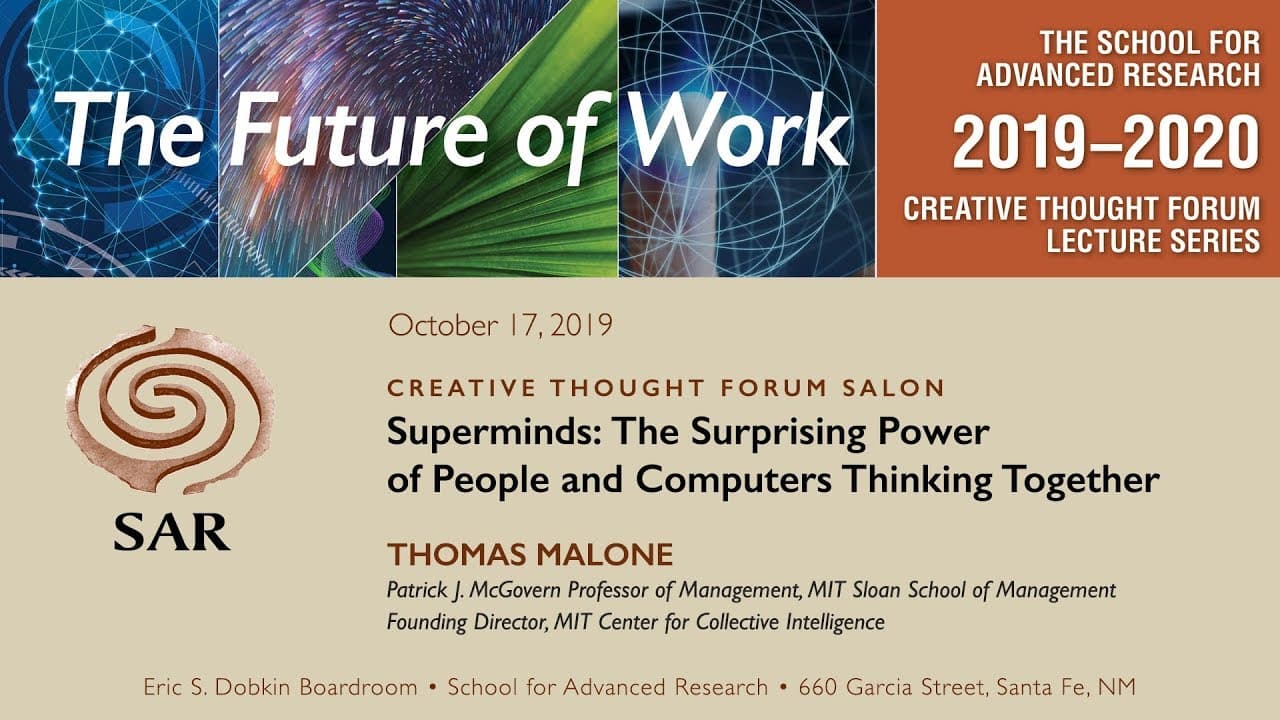
Throughout human history, progress has almost never been made by individuals acting alone, but rather by the power of groups. Thomas Malone calls these groups “superminds” – entities like hierarchies, communities, markets, and democracies that can accomplish far more by drawing upon their collective abilities to create, learn, and make decisions together. In this talk based on his book, “Superminds,” Malone uses striking examples and case studies to show how computers can help create much more intelligent superminds, not just with artificial intelligence, but perhaps even more importantly with hyperconnectivity: connecting people to one another at massive scales and in rich, new ways. These new kinds of human-machine collective intelligence can help us address some of our most important problems in business, government, and other parts of society by, for example, creating jobs, enhancing innovation, and increasing the competitiveness of companies, regions and nations. Malone’s presentation is a practical guide to how groups that use computers to leverage their human intelligence can optimize their new power without losing sight of their human goals.
Books by Tom Malone

Superminds: The Surprising Power of People and Computers Thinking Together
Little, Brown and Company, 2018
Handbook of Collective Intelligence
MIT Press, 2015
The Future of Work: How the New Order of Business Will Shape Your Organization, Your Management Style and Your Life
Harvard Business Press, 2004
Inventing the Organizations of the 21st Century
The MIT Press, 2003
Organizing Business Knowledge: The MIT Process Handbook
The MIT Press, 2003
Coordination Theory and Collaboration Technology
Psychology Press; 1 edition, 2001Tom in the Media

In Conversation with Thomas Malone

What AI Got Right: Lessons for the Rest of the Business World

When Humans and AI Work Best Together – and When Each is Better Alone

Humans and AI: Do They Work Better Together or Alone?
AI Will Profit From Artists, But New ‘Learnright’ Laws Could Help

MIT Expert on Work Says Any Boss Who Thinks Employees Will Return to Offices is Dreaming

Why We Need a 'Digital WPA' Similar to the Depression-Era Works Progress Administration

Wall Street Journal logo What AI Will Do to Corporate Hierarchies
Superminds: How Humans and Machines Can Work Together

How AI is Changing Knowledge Work: MIT’s Thomas Malone
Expanded Opportunities in the New Workplace

By the Definition of Consciousness, Apple Could Be Considered a Conscious Organism
We at IBM value the perspectives you brought to our session and appreciate the time you spent with us.
Ginni Rometty IBM ChairmanPresident and Chief Executive Officer
Bring Tom to your next event
Tell us about your event and we will be in touch right away.


