

Watch Julie in Action
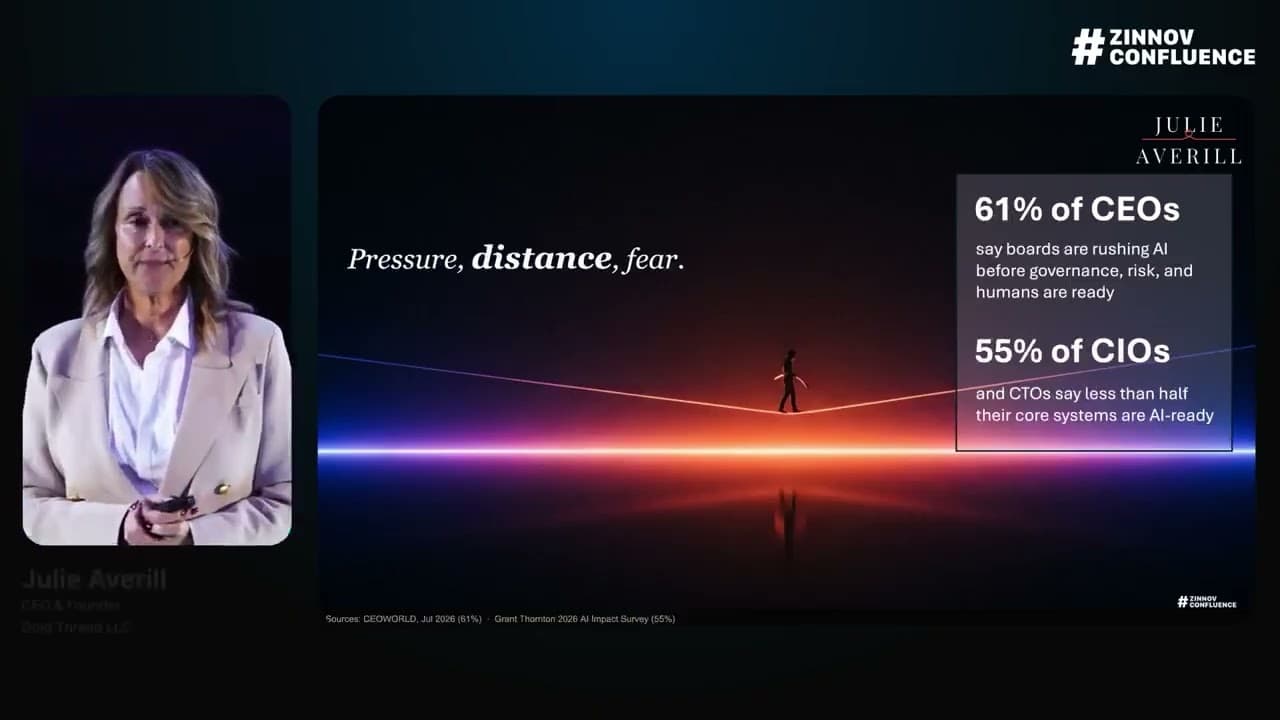
About Julie Averill
At lululemon, Julie Averill reported directly to the CEO and built and led global teams across the United States, Canada, China and India, reshaping ecommerce, retail, supply chain and cybersecurity The India Technology Hub, which she launched and built with nearly 50% women engineers in a market averaging 34%, was recognized with NASSCOM's AI Game Changer Award. Before lululemon she was REI's first chief information officer, and before that she spent more than a decade at Nordstrom helping pioneer the early omnichannel capabilities that connected digital and physical retail.
Her work centers on a single argument: AI does not fix an organization's culture, it reveals it. That argument anchors her book Chief Impact Officer. TIME excerpted the book, and in the weeks after her New York Times guest essay ran she took the case to CNBC's Squawk Box, Bloomberg's The Close, NBC Bay Area's Press:Here and KING 5 News in Seattle.
Julie's Keynote Topics
Hypergrowth exposes every structural weakness a company has, and Averill has managed that exposure at scale. During her tenure at lululemon she reshaped ecommerce, retail, supply chain and cybersecurity while standing up technology hubs across four countries and building the operating model to hold them together.
The talk is organized around what breaks and in what order. Decision rights break first, usually before anyone notices, because the people who used to decide informally are now three time zones and two layers away. Then the operating model, when a company keeps adding headcount to a structure designed for a smaller version of itself. Then trust, when the distance between the people doing the work and the people deciding about it becomes wide enough that information stops moving in both directions. Averill is specific about which foundations have to be load bearing before the next expansion, and which can be built after.
The clearest example is lululemon's India Technology Hub, which she launched and built with nearly 50% women engineers in a market averaging 34%. The result came from designing inclusion into the hiring and operating model from the beginning rather than retrofitting it, and the work was recognized with NASSCOM's AI Game Changer Award. She uses it to make a broader operational point: distributed teams underperform when they are treated as cost centers and outperform when they are built as capability partners with real ownership and real decisions.
Executives leave with a model for sequencing growth investments, and with a read on which of their own foundations are currently carrying more weight than they were built for.
The talk opens where the audience actually is. You have worked twice as hard to earn half the doubt. You have been the only one in rooms where that mattered. And now the technology arrives and everyone behaves as though the game has reset, as though nobody has an edge any more. It was never a level playing field, and the skills built navigating that one, reading a room, building trust without authority, leading through ambiguity with no safety net of assumed competence, are not soft skills. They are precisely what this moment demands of every leader.
The numbers underneath are not encouraging, and Averill does not soften them. Men are significantly more likely to use AI daily at work, women are meaningfully less likely to receive manager support to use it, and a 2026 study found that women make up 86 percent of workers who are both highly exposed to AI job loss and least able to adapt. Her argument is that those numbers are a starting line rather than a verdict, and that the response is not to become more like the loudest person in the AI conversation.
She makes the case through three stories rather than a framework. A coffee house in Ethiopia, where competence got her there and presence got her her son. A room in December she could not manage, plan or fix, and did not need to. And the decision to leave the best job she ever had, from a company she had built well enough that it no longer needed her. The through line is that presence is not passive, that it is the hardest leadership choice available, and that you do not need a plan B when you are fully in the room.
It closes on the claim in the title. Leadership cannot be automated. Not the kind that walks into a room with no plan and stays anyway, or tells people the truth when the truth is hard, or builds something so good it eventually does not need you. Audiences leave with their own experience reframed as an advantage rather than a disadvantage, and with a decision to make about where they are still waiting for permission.
Averill has sat on both sides of this table. For eight years she presented quarterly to lululemon's board as a public company CIO, building and answering for the technology, cybersecurity and AI strategy that went into the deck. She now serves on the board of Gorilla Commerce and the University of Washington Foundation Board, and she completed eight years as an independent director of INDOCHINO, where she was the company's first independent board member.
She does not offer a governance framework. Boards have those. What she offers is the other half of the conversation: what a management team knows about its AI program that does not reach the board deck, and why it does not. Which pilots are genuinely on a path to production and which are being kept alive for the slide. What "we are piloting AI" is usually covering for. How to evaluate an AI strategy without being the person in the room who understands the technology.
She is equally direct about the risks boards are underweighting. Third-party technology exposure, where the liability arrives through a vendor's product and lands on your company's name. The question of what "AI expertise" on a board actually means, which most boards have not defined and are recruiting against anyway. And the gap between what a board is shown quarterly and what it would need to see to know whether anything is working.
Directors leave with better questions. Executives preparing for board scrutiny leave knowing which questions are coming, which is the more useful preparation.
Organizations run credible pilots, then discover that nothing carries into production because the surrounding system was never prepared to absorb it. Decision rights are unclear. Teams protect territory. People closest to the work can see that the results are being oversold, and they have learned it is safer to stay quiet.
Averill walks through the pattern as she lived it. The vendor parade that arrives with extraordinary demos and no questions about your data, your systems, or how you actually work. The pilot that dazzles and then meets a dozen systems that do not agree with each other and decades of exceptions layered on top. The meeting where a room full of people who knew better still wanted the promises to be true, and said no later than they should have. She is candid that this is not a story about other people's judgment.
She then follows the cost. In a single month American employers announced 97,000 job cuts and attributed 40 percent of them to AI, while about a third of the managers who cut a role for AI had already rehired for it. Work does not disappear when a position does. It moves onto the people who stayed, who then watch the company hire back the capability it said a machine had replaced, and draw the obvious conclusion about what they are being told.
The value is diagnostic. Leaders leave able to interrogate their own AI portfolio: which investments are producing capability, which are producing narrative, and which organizational conditions have to change before the next round of spending is justified. They leave able to tell a pilot that is genuinely on a path to production from one that is quietly stuck, and to ask a vendor the question that ends the demo early.
Books by Julie Averill

Articles by Julie Averill
I Helped Run Lululemon. Companies Need to Stop Kidding Themselves About A.I.
August 2026ForbesCIOs: Your Real Mandate Is Belief
June 2026TIMEHow to Make an Impact in the AI Economy
June 2026Chief ExecutiveYou Don’t Need An Innovation Team. You Need Problem-Solvers
June 2026ForbesAI Layoffs Are A Substitute For A Strategy
May 2026ForbesThe One AI Question Boards Should Stop Asking Their CEOs
April 2026ForbesAI Doesn’t Own The Customer Yet. Here’s How Retailers Can Keep It That Way
March 2026Julie in the Media

Culture as Competitive Infrastructure: Why Transformation Isn't About Tech: Julie Averill

Helping AI succeed in retail: Turn pilots into measurable impact

Why the Best Tech Leaders Put People Before AI

Why Most Companies Are Getting AI Wrong

Gold Thread CEO Julie Averill on the challenges companies face implementing AI
She Helped Scale Lululemon to $10 Billion - Now She Warns Investors About AI Cover Stories
Julie Averill: How She Helped Scale lululemon From $2B to $10B & Led Its Tech Transformation
AI’s First Inning: Julie Averill, Former Lululemon & REI CIO and Author of Chief Impact Officer, with Menachem Salinas, Co-Founder & CRO of Nimble
Why Real Transformation Is Human

The AI Headlines You Should Be Most Suspicious Of
The Importance of Centering Our Humanity Over the A.I Machine
The CIO Who Bet Her Job on Her Team — and Won
Bring Julie to your next event
Tell us about your event and we will be in touch right away.


