


Watch Tammy in Action
About Tammy Erickson
Tammy Erickson starts from an uncomfortable premise: the leadership practices that served companies well for the past half-century are not right for today. Success now depends on people leaders cannot script, employees who sense changes in customer needs, innovate solutions and form agile networks. That kind of work cannot be produced by standardized processes, efficiency metrics or decisions cascaded from the top. It requires creating environments people will choose to join, and in which they will freely choose to do great work.
Erickson has worked with senior leaders around the world to build companies infused with new ideas and passionate, engaged people. Her perspective draws on a decade of corporate-funded research into engagement, innovation, collaboration and the changing workforce, including one of the largest and most rigorous studies of collaborative behavior within organizations. She teaches her D-I-C-E model for leading intelligent organizations: Disrupt, Intrigue, Connect and Engage.
Tammy's Keynote Topics
Let’s step back and make sense of what’s really happening. Today’s sense of disruption is:
- More than the pandemic
- More than rapidly advancing technologies
- More than changing client and workforce preferences and priorities
What is driving the “future of work” and why does it feel so disruptive?
These are the urgent issues award-winning executive educator and leadership advisor Tammy Erickson addresses in this important presentation. She explores a range of business challenges: how to be innovative, adaptable, sense and anticipate customer needs, build agile, collaborative networks, and how to customize, experiment and learn. She discusses why most organizations and most leaders are not set up to optimize doing these things well, mainly because most organizations have grown out of a time when success depended on scale and efficiency; the structures and practices that were optimized for that challenge. For example:
- Authority through command-and-control – “cascaded” directives from the top
- Emphasis on efficiency and utilization metrics – measurement of productivity by time
- Bureaucratic structures to align multiple inputs
- Proliferation of “schoolhouse rules” designed to prevent individual action
For scale and efficiency, these practices were perfect. Today, success requires mobilizing intelligence – and doing that well requires different organizations structures, practices and leadership approaches than required for scale and efficiency.
The need to mobilize intelligence is now, Erickson emphasizes. The future of work is catching up with this reality, creating organizations optimized to do this well and leading in ways that encourage every employee to invest their best efforts.
She then explains how companies can stand out as exemplars, and rank among the best in 2030. She outlines what capabilities are required to differentiate their business today and how leaders can develop clarity and focus on the most important activities – an essential starting point for considering the role of leaders and the shape of the organization.
The principles that drove the design of organizations over the past century were brilliant at achieving scale, low cost, and consistent quality. But they are detrimental to the capabilities and skills required today: initiative, innovation, insight and collaborative actions. The essential principles for today’s organizations include options, choices and trust. Erickson provides insightful, thought-provoking and pragmatic examples of how to create options, allow more personal choice, and build trust.
Options are essential for giving organizations the agility required to address today’s uncertain future and are the cornerstone of meeting the preferences of a diverse workforce. Award-winning executive educator and leadership advisor Tammy Erickson takes leaders beyond the platitudes of “be agile” to show how an “Own Less/Coordinate More” mentality (get what you need when and where you need it) makes it possible.
Choices allow intelligent adults to select work options that make sense for them. Erickson will share provocative ideas, such as pay per task, not time and why it’s important to stop measuring predominantly hours billed. Judge the quality (and quantity, and timeliness) of the work performed, says Erickson, and let people bid on the projects they would like to take on. Companies must give people a reason to choose their organization – to opt in – an approach that will simultaneously scare away those who would probably not like the culture.
Two-way trust is a core principle of a contemporary organization: build your trust in your team; it will build their trust in you. Eliminate “school” rules – encourage a community of adults. Help people feel secure by giving them commercially valuable credentials, such as badges. Articulate logical skill progressions; require observable, objective accomplishments. Eliminate assessments based on subjective, judgmental attributes.
These principles – options, choices and trust – are the cornerstone of organizations that can be optimized for today’s work, workforce and environment.
We are on the brink of an important transformation. New technologies are making their way into the workplace offering significant improvements in generating, capturing and sharing knowledge; finding helpful colleagues and information; tapping into new sources of innovation and expertise; and harnessing the “wisdom of crowds.” Over time, these collaborative technologies will change the way work is done and the way organizations function. They will shift the way we interact with people on our teams, find external expertise when it’s needed and share ideas and observations more broadly.
Identifying relevant business connections isn’t as clear cut as finding old high school friends. The range of activities that collaborative technologies can take on to enhance performance and drive increased productivity in the workplace is far broader than the activities most of us have explored during our personal use. Perhaps most importantly, many of our existing work practices actually hinder the successful use of extended collaboration.
How do you transform an organization that doesn’t have a collaborative culture? Which practices are essential to move in that direction? Which companies are taking new and interesting approaches to the ways they work, leveraging today’s capabilities? What do they tell us about the characteristics of organizations that excel at extended collaboration? Based on several years of deep research into the barriers and motivations for organization-wide collaboration, Tammy Erickson provides sound guidance on re-shaping your organization for future success.
Two of the critical elements of award-winning executive educator and leadership advisor Tammy Erickson’s D-I-C-E model are to Disrupt and Intrigue. “Leaders must ensure new perspectives are always part of the organization’s view,” says Erickson. In this talk, she offers leaders practical approaches for:
- Inviting provocative or unsettling ideas
- Sending people out to see what others are doing
- Legitimizing and celebrating diverse ideas and new perspectives
- Creating time to “think;” a habit of thinking together
- Asking “How Might We” questions to draw others in
- Encouraging experimentation
- Using design thinking tools and a focus on specific customers to develop deep insight into behavior and need
The next demographic wave is almost ready to hit the shore. Children who are 15-and-under today are almost certainly not members of Generation Y. They’ve been influenced by a very different set of global events than those that shaped the ideas and preferences of people in their late teens and 20s today.
Today’s children have been forming their mental maps of the future at a time when our national and global optimism has been doused with the cold water realization that we are facing significant, seemingly intractable problems on multiple fronts. The inconvenient truths of the past half century – precarious global finances, resource constraints, shifting economic power and environmental degradation – are settling around our shoulders, and these early teens are not unaware of these issues or their complexity. This generation’s perspective is based on a world with finite limits and no easy answers.
What is this new generation, soon to be the fifth generation in many workplaces, all about? What do they value and how might they shape both the future of work and of the marketplace? Tammy Erickson’s in-depth research brings the “Re-Generation” into sharp focus, with insights for employers, marketers, educators…and parents.
Geography significantly influences the formation of generational beliefs and behavior. Each country’s unique social, political and economic events shape specific views and attitudes among today’s adults. Understanding these country-to-country differences is critical to creating employment opportunities that attract and retain the best employees in each geographic area.
Tammy Erickson’s research has extended to the generations in a number of specific countries around the world, including the four BRIC nations, as well as countries in Europe and the Middle East. She will work with you to develop a customized session, focusing on the areas of the world that are most important to your business – or provide an overview of the similarities and differences within one generation around the globe.
Understanding individuals’ backgrounds and resultant perspectives or mental models, both within generations and across geographies, helps leaders grapple with the diversity, challenges and potential of a global workforce.
The conditions imposed by the pandemic are requiring leaders to go above and beyond the norm to build intelligent organizations in an era of unpredictable change. How does leadership change in a virtual work environment? How can companies address the growing wave of resignations?
Many of award-winning executive educator and leadership advisor Tammy Erickson’s sessions highlight the specific challenges posed by today’s work environment and offer practical ways companies and individual leaders can be more successful.
The heart of innovation is the combination of two previously unrelated ideas. Creating the capacity for innovation in your organization means encouraging collaboration: namely, sharing knowledge and working together to create new ideas. The paradox: many of the best ways to encourage collaboration work against innovation! How can you balance both?
Based on groundbreaking research – one of the largest and most rigorous studies of collaborative behavior within organizations – as well as years of experience with innovative organizations, three keys emerge: building the capacity to collaborate, asking great questions, and introducing sufficient diversity of thought and capability. Tammy Erickson identifies the highest-priority investments and practices needed to build an organization skilled at successful innovation.
This is a fresh look at one of the most challenging aspects of leadership today – creating an organization filled with the on-going spark of new ideas. Others address innovation from a process perspective – how to manage the development of innovations once an idea has surfaced, or provide a strategic overview. Erickson brings her unique organizational understanding to outline the embedded practices that create a culture of sustained innovation.
Four generations are working together in today’s workplace – and a fifth is on the way. Each brings unique assumptions to the job. As a result, events in the workplace are often interpreted differently by individuals in different generations. What may seem like good news to a Boomer might well be an unsettling and unwelcome development to a member of Generation X; things that members of Gen Y love often seem unappealing or frivolous to those in older generations.
Today, it’s increasingly important to create a culture that is welcoming and engaging for talented individuals of all ages. Based on years of in-depth research and three books on generations in the workforce, Tammy Erickson helps audiences understand the underlying evolution of the assumptions each generation brings to work, with humor, empathy and enormous insight. Combining rich data and unparalleled research with her optimistic point of view, she offers practical strategies and actionable insights so audiences of all ages will better understand each other.
Is your organization designed to take full advantage of digital innovation? Are you optimized to solve the most important challenges your organization faces? Throughout history, each time the business environment changed, the companies that excelled were those that developed new leadership and organizational practices – innovative responses to address the most differentiating challenges. In this talk, Tammy Erickson explores contemporary changes that require new organizational designs: changes in the way value is created, the way work is organized, how work is managed and integrated, what people want from work, how organizations relate to those who work, and the fundamental challenges that will make your organization iconic. She will share practical ideas to ensure your organization is built to excel today – and in the future.
How do you transform an organization that doesn’t have a collaborative culture? New technologies are offering emerging opportunities for people to generate, capture and share knowledge, connect with helpful colleagues and information, tap into new sources of innovation and expertise, and harness the “wisdom of crowds.” These collaborative technologies are quickly changing the way work is done and the way organization function, and the pandemic has hastened the speed of change.
Based on her years of deep research into the barriers that prevent and motivations that create organization-wide collaboration, award-winning executive educator and leadership advisor Tammy Erickson provides sound guidance on re-shaping your organization for future success. In this talk, she offers leaders tools for:
- Building trust-based relationships
- Developing networks
- Making communications easy and efficient
- Role-modeling cooperation
- Allowing time for socialization
- Organizing events specifically to create new relationships
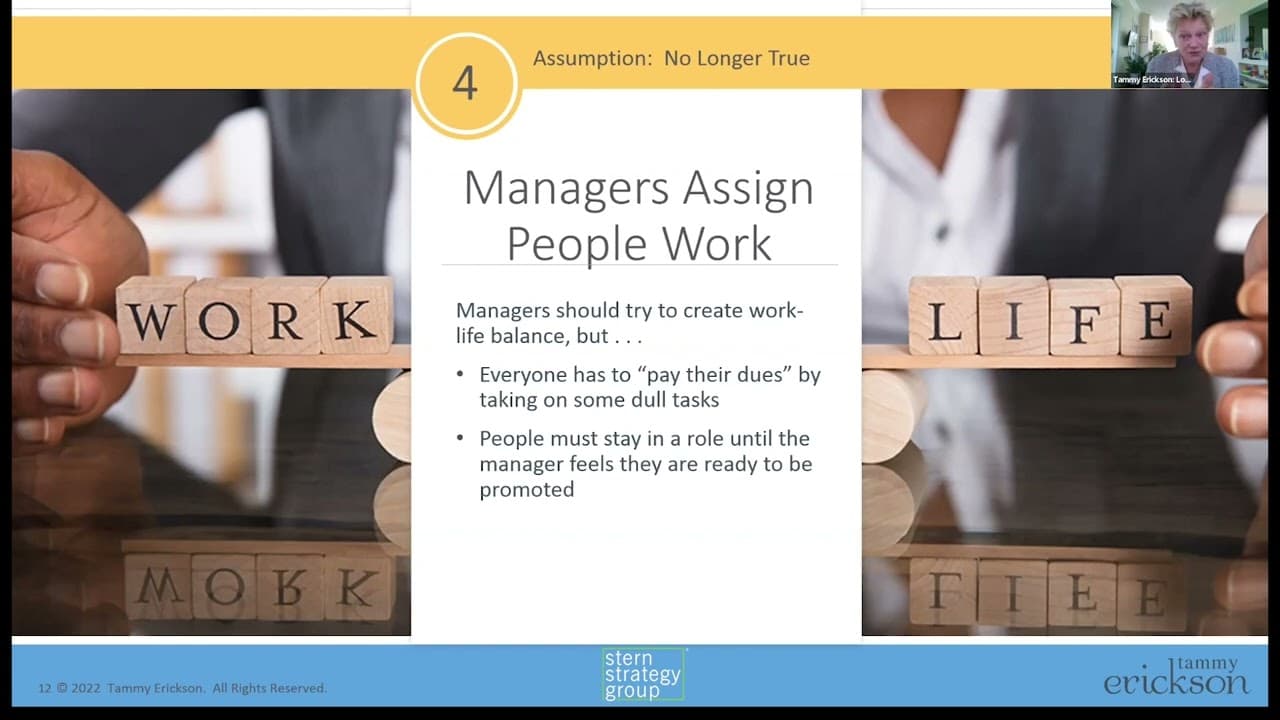
Today’s organizations are ripe for change. Over the next several decades, we’ll see very different business entities evolve. Why? Because today’s organizations were designed in response to conditions that no longer exist. Do you still think loyal behavior at work will lead to a lifetime of protection and care from the corporation? Of course not. But many of our cherished talent management practices that are based on tenure, from pension plans to perquisites, like vacation, are holdovers from the days when this old assumption rang true.
There are many new business realities that we haven’t yet translated into our management practices and organizational designs. It’s time to question which practices still make sense and whether there are new options better suited to today. In this provocative and interactive session, Tammy Erickson will highlight 10 assumptions that underpin organizations, all of which have major implications for the way we manage talent and run organizations, and yet none are true today. She’ll leave participants looking at their organizations – and themselves – through a whole new lens.
Books by Tammy Erickson

What's Next, Gen X?: Keeping Up, Moving Ahead, and Getting the Career You Want
Harvard Business Review Press, 2009
Plugged In: The Generation Y Guide to Thriving at Work
Harvard Business School Press, 2008
Retire Retirement: Career Strategies for the Boomer Generation
Harvard Business School Press, 2008
Workforce Crisis: How to Beat the Coming Shortage of Skills and Talent
Harvard Business Review Press, 2006
Third Generation R & D: Managing the Link to Corporate Strategy
Harvard Business Review Press, 1991Tammy in the Media

10 Things Leaders Need To Do Now

2020: What Happens Now?
6 Trends to Look Out For in 2019
Talented People Must Choose To Do Great Work: Curate A Culture ($)
How Did You Become What You Are Today?
HR Must Lead in Creating New Organisations
Preparing Businesses for the Next Generation of Workers
Why You Have a 90% Chance of Being Fired -- But May End Up Better Off
The Best Companies to Work for in 2016
Women Still Face Battle to Enter the Boardroom
Don't Underestimate Women
Value-Based Diversity: The Challenges and Strengths of Many
Tammy Erickson was a phenomenal success! Our President said it was the best presentation of that type he’s ever heard and we are thrilled! We had people clamoring for copies of her presentation and it was a great idea to place her first on the program as she set the tone for the day and raised the bar considerably. It’s always a good sign when no one even gets up to grab coffee!
Mary WeeklyAmerican Gas Association
Thanks again for a fabulous presentation and discussion. Very well done. Very informative and engaging. I really really appreciate the effort you made to engage the team on this topic. Many implications for our firm.
Steve MilovichSVP Human Resources, Walt Disney Company
Bring Tammy to your next event
Tell us about your event and we will be in touch right away.


